A Generative AI Critique of a Budget and Legislative Analyst
Report for Supervisor Walton
to Assess Costs of
Mayor Lurie’s “Clean Up City Hall” Ballot Measures …
Reveals
the BLA’s Sloppy Work — AI Gives “C-Minus” Grade
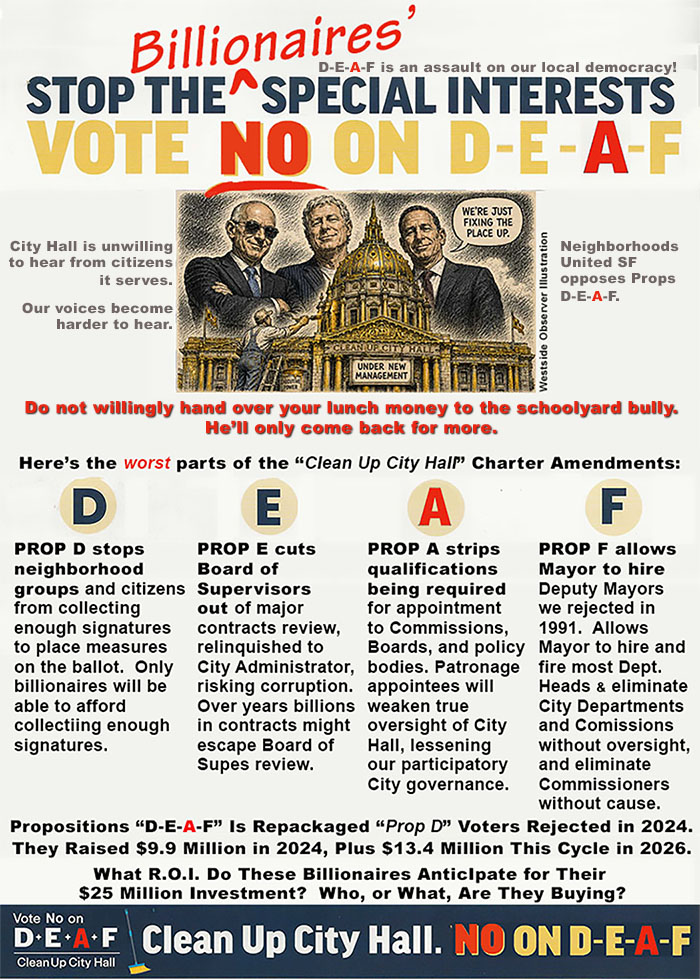
On July 14, Supervisor Shamann Walton requested that the Board of Supervisors Budget and Legislative Analyst prepare an independent cost analysis of the three Charter reform measures proposed by Mayor Lurie for the November 2026 ballot: “Proposition D,” Changes to Ballot Measure Process; Proposition “E,” Extending the City Administrator's Duties and Changes to City Contracting; and “Proposition F,” Changes to Executive Branch Management.
Walton requested the analysis be completed by September 8, 2026 so that voters, city officials, the press, and community organizations would have sufficient have time to review and act on this information well ahead of ballots being cast, not after the fact.
In fairness, most members of the public had no idea Walton had requested the BLA’s analysis during a Board of Supervisors meeting on July 14 until news of the BLA’s draft analysis surfaced on September 25 when the Boad of Supervisors meeting agenda for September 29 was published online, which is not a forum voters or most reporters reply on.
When the 55-page draft analysis first surfaced, it was as an unfinished document without an Executive Summary and no ballot letters, buried in the meeting agenda packet. The 57-page final version of the BLA’s analysis (excluding some back matter) only surfaced as a result of a public records request to the BLA on October 12 — just 21 days before the election on November 3, and fully 33 days after Walton’s requested September 8 due date.
1. |
Supervisor Shamann Walton’s July 14, 2026 request for Budget and Legislative Analyst (BLA) “Independent Cost Analysis of Charter Reform Ballot Measures” (posted in Board of Supervisors September 29 meeting agenda in “Petitions and Communications” section. |
2. |
BLA’s “Draft Policy Analysis Report” 55-page response, “Analysis of Selected San Francisco Charter A Proposed or November 2026 Ballot.” The BLA’s initial undated draft incomplete report lacked an “Executive Summary.” The due date was September 8, but was only posted on-line on September 25 in the Board of Supervisors September 29 meeting agenda in the Petitions and Communications” section. |
3. |
An initial generative AI critique of the BLA’s “Draft Policy Analysis Report” titled “What Walton Asked,W hat the BLA Said, and What It Ducked” to Supervisor Walton. The AI critique was completely damning of the BLA’s analysis. |
4. |
BLA’s “Final Policy Analysis Report,” dated October 8, 2026, 55-page response. Became available through a public records request placed at 8:49 p.m. Monday, Indigenous People’s Day; BLA’s Fred Brousseau responded by e-mail 36 minutes later at 9:25 p.m. and that Federal Holiday. |
5.
|
A subsequent generative AI critique of the BLA’s “Final Policy Analysis Report” titled “The BLA’s Charter Reform Analysis: Draft Versus Final” and dated October 8, 2025 to Supervisor Walton lowered an overall grade to a “C-minus,” were the BLA’s report to have been prepared for a hypothetical graduate-level course in Government Policy Analysis. The generative AI critique graded the BLA’s report on two areas of usefulness: 1) Responsiveness to Walton’s inquiry request (which received a grade of “C”) , and 2) As a Public Policy document to assist taxpayers and voters (which received a grade of “D-plus”). It’s not known if the grade the generative AI assigned was due in part to the final analysis having become available 33 days after the requested due date! |
The final version missed every official voter-information channel. The Voter Information Pamphlet, with its Controller’s statements, ballot simplification digest, official Proponent and Opponent arguments, and paid voter guide arguments, was posted online before either version of the BLA’s analysis became public. Ballots were in mailboxes six days before the date of the final report surfaced, and ten days before it was obtained as a public record by one citizen.
Anyone who had already voted by October 8 decided how to cast their votes without the benefit of the BLA’s finished analysis. And because the BLA’s final report has not been posted online by October 14, voters have been left in the dark.