 Printer-friendly PDF file
Article Written: September 5, 2016
Published: January 2017
Joel Engardio and Heather Knight Don’t Know What They’re Talking About
Mayor Ed Lee’s Five-and-a-Half Year Hiring Binge
Printer-friendly PDF file
Article Written: September 5, 2016
Published: January 2017
Joel Engardio and Heather Knight Don’t Know What They’re Talking About
Mayor Ed Lee’s Five-and-a-Half Year Hiring Binge
by Patrick Monette-Shaw
On August 27, 2016, San Francisco Chronicle columnist Heather Knight published an article — “Billions of Dollars Flow to SF’s Army of City Workers ” — that was laced with factual errors.
Perhaps it wasn’t Knight’s fault, and perhaps copyeditors and proofreaders, and other editors up the food chain helped mislead readers. Or, perhaps it was her own fault for not researching the actual underlying data behind the story.
For whatever reason, she utterly failed her duty as a member of the Fourth Estate to research and report factual information.
She may have been aided by incorrect assumptions put forth by perennial wanna-be District 7 Supervisor, Joel Engardio, who’s running again, mistakenly believing residents will now elect him, after they rejected him at the ballot box in 2012 for the office when he came in fourth place with just 13.29% of the vote.
Joel Engardio’s Mistake
 Knight quoted District 7 Supervisorial candidate Joel Engardio, who noted West Side residents don’t know where their annual property taxes go. “People are feeling like they are being used as an ATM at City Hall,” Engardio said, apparently referring to approximately 30,000 City employees.
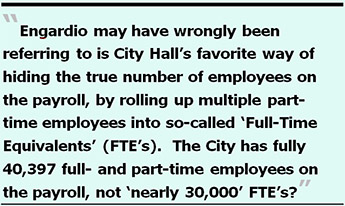
As of June 30, 2016, the City does not have “nearly” 30,000 employees. In response to a response to a public records request, on August 5, 2016 the City Controller provided the city payroll database for the Fiscal Year ending June 30, 2016 (FY 2015–2016) showing that the City has fully 40,397 full- and part-time employees on the payroll, not “nearly 30,000.”
What Engardio may have wrongly been referring to is City Hall’s favorite way of hiding the true number of employees on the payroll, by rolling up multiple part-time employees into so-called “Full-Time Equivalents” (FTE’s).
On August 29, the City Controller also provided historical data in response to another records request showing the number of FTE’s added in various fiscal year City budgets:
Table 1: FTE Counts Across Fiscal Years
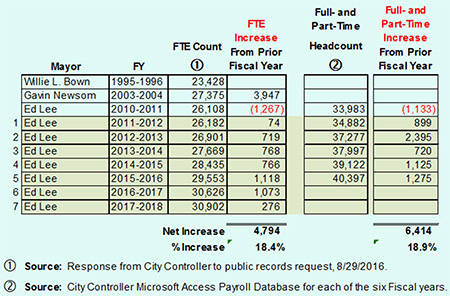
Table 1 shows there were less than 30,000 FTE’s at the end of FY 2015–2016, but we’re now into the two-year budget cycle, and the FTE count through FY 2017–2018 is already projected to be nearly 31,000 FTE’s, and will likely go even higher when the “final” second-year budget for FY 2017–2018 is proposed by the Mayor and approved by the Board of Supervisors in June 2017. Clearly, Engardio was referencing already out-of-date budget information.
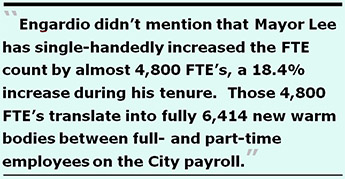 As far as that goes, Engardio didn’t mention that in the seven budget cycles Mayor Lee has been responsible for starting in FY 2011–2012 after inheriting the final budget Gavin Newsom had adopted for FY 2010–2011 when Lee assumed office in January 2011 half-way through that fiscal year, Mayor Lee has single-handedly increased the FTE count by almost 4,800 FTE’s, a 18.4% increase during his tenure. (By contrast, Mayor Willie Brown only added 3,947 FTE’s across his eight-year tenure, compared to Lee’s 4,800 FTE’s added in just seven years of budgets he developed, and he still has two fiscal years to go following FY 2017–2018.)
But the 4,800 FTE’s Lee has added translates into fully 6,414 new warm employee bodies between full- and part-time employees on the City payroll during the same period, which will likely grow to even more full- and part-time employees. Take for instance, that the 719 new FTE positions in FY 2012–2013 had translated into 2,395 new full- and part-time employees, and the 766 new FTE positions in FY 2014–2015 had translated into an additional 1,125 new full- and part-time employees. And we won’t learn how many of the additional 1,073 FTE positions in the current fiscal year budget (FY 2016–2017) will translate into actual full- and part-time new employees until approximately August 2017. And more than likely the 276 FTE’s Lee is planning to add in FY 2017–2018 will probably grow by the time that budget is actually adopted in June of 2017.
 It’s also clear is that Mayor Lee has been on a patronage hiring binge since his first independently-submitted budget in 2011–2012 following inheriting his predecessor’s budget when he was sworn in mid-way through FY 2010–2011. What’s clearer is Engardio cited “almost 30,000” employees (referring to the 29,553 FTE’s in FY 2015–2016) when there were, in fact, 40,397 full- and part-time employees on the City’s payroll, clearly off by over 10,000 employees. And it’s clear Lee’s hiring binge is nowhere near over.
Heather Knight’s Many Mistakes
 While Knight is correct that the budget for FY 2016–2017 that started on July 1, 2016 has a budgeted FTE count of 30,626, she should have known that the actual full- and part-time count of actual employees stood at 40,397 for the previous fiscal year period that ended on June 30, 2016, shown in Table 1 above.
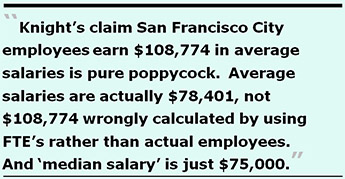
 Knight used “averages” (the “mean”), rather than the median salary. Of the 40,397 full- and part-time employees in FY 2015–2016 the “median” salary is for the employee sitting on slot number 20,197 in an ascending sort of Total Pay (the “middle” employee), one Ms. Amy Kwan, a Medical Social Worker in the Department of Public Health, whose “Total Pay” was just $75,000, a little shy of the $78,401 “average” salary.
 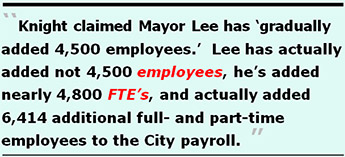 Knight claimed that in his 5-½ years in office, Mayor Lee has “gradually added 4,500 employees,” and next year’s budget [presumably the current fiscal year budget for FY 2016-2017] is projected to “add another 300 workers.”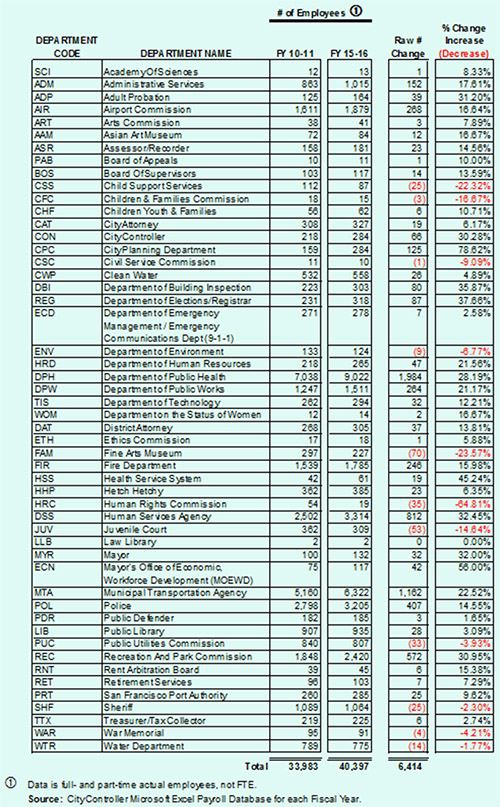
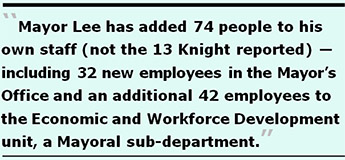 In fact, since taking office Mayor Lee has added 407 people to the Police Department, (not 300), added 1,162 people to MUNI (not 1,000), and added 1,984 people to the Department of Public Health (not 1,100). As well, Lee added 28 to the Public Libraries (not a “few dozen”), added a “572 employees to the Recreation and Parks Department (also not a “few dozen”), and added 74 people to his own staff (not 13) — including 32 new employees in the Mayor’s Office itself and an additional 42 employees to the Economic and Workforce Development unit, which is a sub-department reporting to the Mayor, as in the Mayor’s Office of Economic and Workforce Development (MOEWD). Why did San Franciscans need 42 additional employees at MOEWD, or for that matter 32 more staff in the Mayor’s Office?
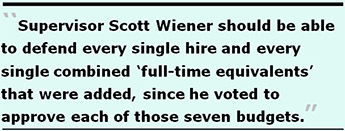 This claim is completely comical. Supervisor Scott Wiener was sworn in to office on January 8, 2011, three days before Mayor Lee was sworn in on January 11, 2011. Wiener should know that during Mayor Lee’s tenure, he has added 4,794 additional FTE’s that translate into an additional 6,414 full- and part-time employees (shown in Table 1), and the City now has at least 40,397 employees, not 30,626 “workers.” Wiener is also referring to the FTE counts, not the actual number of City full- and part-time employees.
More on the “Average” Salaries Malarky:
As Table 4 shows, there’s significant disparity and income inequality for those earning less than $100,000 annually vs. those earning over $100,000 annually. Although the row shaded in green shows a citywide “average” of $78,401 for all 40,397 employees, the rows shaded in yellow show that the 24,605 employees who earn less than $100,000 — well over two-thirds of all City employees — averaged just $49,532 in annually salaries, while the 9,378 employees (just under one-third at 31.1%) averaged whopping $142,414 average annual salaries.
Table 4: Expanded Information on Change in “Average” Salaries Since Mayor Lee Took Office
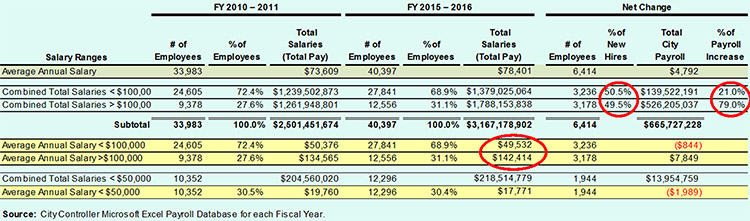
 Looking more closely at Table 4, between the time Mayor Lee took office and the close of FY 2015–2016 on June 30, 2016, the average annual salary for City employees earning less than $100,000 actually dropped by $844 annually to the $49,532 new average, white the average annual salary for City employees earning more than $100,000 increased by $7,849 to the new $142,414 average salary. And for those earning less than $50,000 annually, although there are now 1,944 additional such employees, they are now taking home $1,989 less in average salaries!
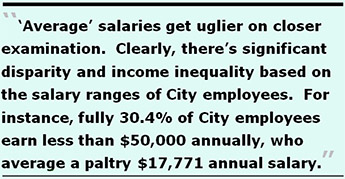
“Average” salaries get uglier on closer examination. Table 5 illustrates more clearly the significant disparity and income inequality based on the salary ranges of City employees. For instance, fully 30.4% of City employees (10,352 ) earn less than $50,000 annually and their average annual salaries are a paltry $17,771.
Table 5: “Average” Salaries by Salary Ranges
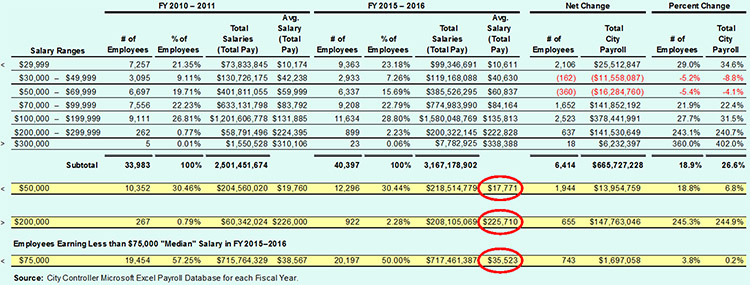
Table 5 illustrates that “average” salaries vary wildly across salary ranges. For those employees earning less than $30,000 annually in FY 2015–2016, they earn a paltry $10,174 in average annual salaries. For those earning between $30,000 and $49,999 annually, their average salaries shrank in FY 2015–2016 to just $40,630.
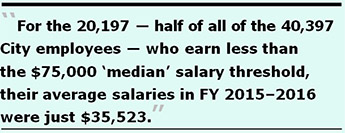 And most notably, for the 20,197 — half of all 40,397 City employees — who earn less than the $75,000 “median” salary threshold (highlighted in yellow), their average salaries in FY 2015–2016 were just $35,523. The most obscene increases occurred in those earning over $200,000 a year, with a 243% change and a 360% percent change in the number of employees earning between $200,000 and $299,999, and over $300,000, respectively.
Under Mayor Lee’s tenure, can Heather Knight, Joel Engardio, or perhaps Supervisor Wiener explain why San Franciscan’s needed an additional 655 City employees earning over $200,000 annually (at an increased cost of $147.8 million more annually), or for that matter, why San Franciscans needed a staggering 2,523 more City employees earning between $100,000 and $199,999 annually?
Clearly, Ms. Knight failed to provide any insight into the nuances of “average” City salaries, let alone the increase of 3,178 employees earning more than $100,000 annually during Mayor Lee’s tenure increasing the City payroll budget by a cool $526.5 million annually — fully 79% of the total $665.7 million increase in payroll since Lee became mayor as shown in Table 4. That’s right: Almost half of Mayor Lee’s 6,414 new hires (those earning over $100K) sucked up nearly 80% of the salary budget increase. Can anyone say “income disparity”?
Other Issues With Mayor Lee’s Hiring Binge
There’s more to the “bloat” in Mayor Lee’s hiring binge.
Table 6: Changes in FTE Status Under Mayor Ed Lee’s Tenure
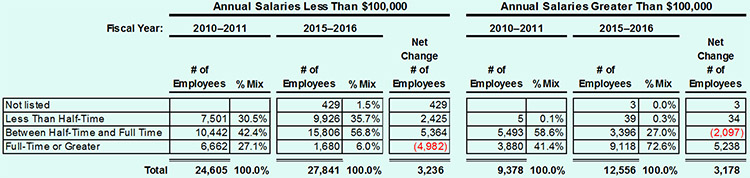
As Table 6 illustrates, Mayor Lee has essentially waged war against City employees who earn less than $100,000 annually since having taken office.
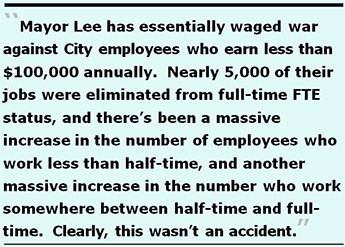 For example, between FY 2010–2011 (when he inherited his predecessor’s final budget) and FY 2015–2016, employees earning less than $100,000 annually have seen nearly 5,000 of their jobs eliminated from full-time FTE status, and instead, there’s been a massive increase in the number of employees who work less than half-time, and another massive increase in the number of employees earning less than $100,000 who work somewhere between half-time and full-time.
By contrast, those earning over $100,000 have seen a massive increase in the number of employees working full-time, a massive decrease in the number of employees who work between half-time and full-time, and between FY 2010–2011 and FY 2015–2016 the number of employees who earn more than $100,000 who work less than half-time has consistently remained below a fraction of even one-percent of employees.
Clearly, this was no accident, and was likely intentional on Mayor Lee’s part. How else do you get “loyalty” out of patronage hiring?
And Knight mentions not one word about why during Mayor Lee’s tenure there has been a massive spike in “managers” employed across the City.
Table 7: Bloat in Citywide Senior Managers Earning Over $90,000 in Total Pay: FY 10-11 to FY 15-16
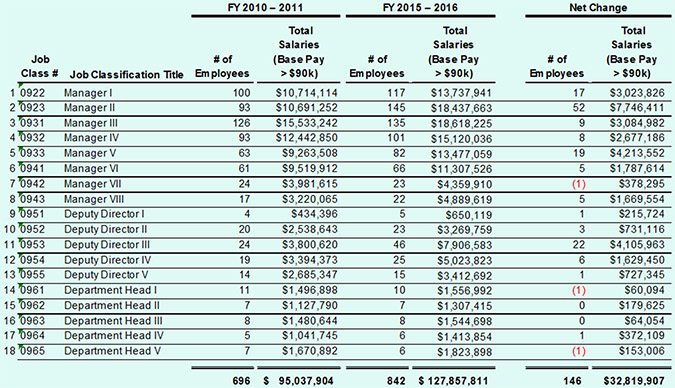
Table 8: Bloat in Muni Senior Managers Earning Over $90,000 in Total Pay: FY 10-11 to FY 15-16
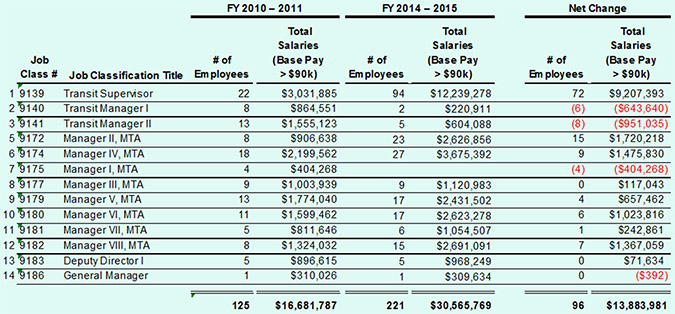
Between the additional 146 senior managers citywide shown in Table 7 and the 96 additional senior managers at Muni shown in Table 8, can anybody explain why we needed an additional 242 senior managers at an increased cost of $46.7 million? How have these additional 242 “senior managers” improved operations of City departments?
And between Table 7 and Table 8, why does San Francisco now need a total of 1,063 of these senior managers (combining citywide and Muni-specific senior managers) at a combined increased cost of $158.4 million annually?
Figure 1: The Growth in the “Over-$100K Club” Keeps Soaring — FY 2010–2011 to FY 2015–2016
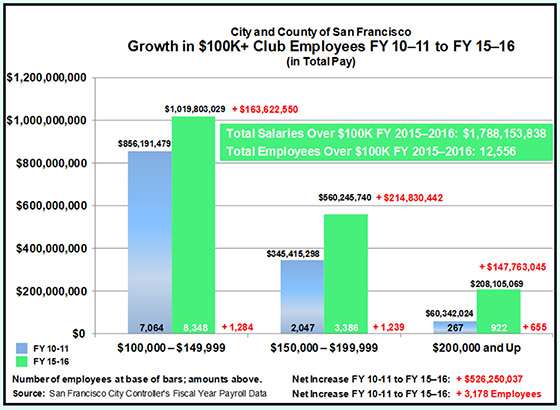
 Figure 1 visually illustrates data in Table 4, showing that there’s been a massive increase of over a half-billion dollars for the now 12,556 City employees earning over $100,000 annually. They represent just 31.1% of the City’s employees, but now consume $1.79 billion — fully 56.5% — of the City’s total $3.2 billion total payroll.
Can anyone explain why San Francisco needs 922 more employees earning over $200,000 annually? Do they make the City run any better or more efficiently? Or is this just part of the “sharing economy” Mayor Lee is so well known for?
Sadly, Ms. Knight mentions not one word about any of this.
Perhaps Joel Engardio or Supervisor Wiener knows whether City operations have improved given this increased bloat, but nobody else does. Apparently, Engardio doesn’t get it that the person pulling City Hall’s ATM patronage job levers is our Mayor.
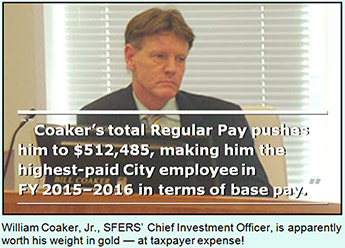 San Francisco’s Highest-Paid Employee
It came as quite a shock to learn on August 5 when I received the City Controller’s payroll database for FY 2015–2016 ending June 30, 2016, that the highest-paid employee is William “Bill” Coaker, Jr., Chief Investment Officer (CIO) at the San Francisco Employee’s Retirement System (SFERS).
In the one-year period between FY 2014–2015 and FY 2015–2016, Coaker received a staggering $205,810 base pay raise and now earns $512,485 annually. He’ll become a new millionaire from the City’s payroll every other year, news Engardio and Ms. Knight — and Matier and Ross — apparently missed.
Importantly, beneficiaries of the Retirement Fund — all active and retired City employees — are likely unaware of Coaker’s current salary and exorbitant raise.
It’s not known what sort of goals or accomplishments Coaker reached in that one-year period to have earned such a fat pay raise, and it is thought SFERS’ board of directors did not have to approve the raise and may not have been aware of it, but Mayor Lee and the City’s director of Human Resources were probably required to sign off on Coaker’s raise.
 Returns on investment of the Retirement Fund have done very poorly over the last two years during Coaker’s tenure as CIO since he was re-hired at SFERS in 2014. For the three years starting on April 1, 2013 and ending March 31, 2016 (slightly before Coaker’s re-hire), the Retirement Fund earned 7.41% per year.
But now under Coaker’s “leadership,” for the 12-month period ending March 31, 2016 the Retirement Fund earned just 1.08%, so it’s a mystery how the Fund’s dismal performance somehow qualified Coaker for such a fat $205,810 raise. What did he do to earn such a performance reward?
Coaker’s predecessor, Bob Shaw, was a job classification code 1117, Deputy Director for Investments, in FY 2012–2013 and was paid $294,342, which was just 57.4% of Coaker’s bloated salary. Another way of looking at it is that Coaker’s salary represents a 74.1% change increase over Shaw’s pay as Director of Investments.
 Coincidentally, as I was finishing this article today, the San Francisco Chronicle’s Matier and Ross also published their column today on September 5 mentioning Coaker is now the highest-paid City employee, but Matier and Ross didn’t bother wading into Coaker’s $205,810 single-year pay raise, nor did they wade into discussing whether Coaker’s performance justified such largesse.
And while Matier and Ross noted that 23 employees “made it over the $300,000 mark this past fiscal year,” the pair neglected to mention that last fiscal year there were only five such employees. The other 18 piled on during FY 2015–2016.
 San Franciscans deserve a top-to-bottom audit of the 6,414 additional full- and part-time employees Mayor Lee has added to the payroll since taking office, and his hiring spree.
Monette-Shaw is an open-government accountability advocate, a patient advocate, and a member of California’s First Amendment Coalition. He received a James Madison Freedom of Information Award from the Society of Professional Journalists-Northern California Chapter in 2012. He can be contacted at monette-shaw@westsideobserver.com.