 October 26, 2025
October 26, 2025
You Can’t Fool San Franciscans When It Comes to Our Local Democracy
Streamlining Task Force’s Double-Cross Continues
Streamlining Task Force Member Andrea True (née Bruss) Suddenly Appointed as
“Director of Government Legal Reform” in the City Attorney’s Office,
Hired the Same Month the Task Force Was Convened. Go Figure!
Mayor Lurie’s Own “Project 2025”
by Patrick Monette-Shaw
When it comes to trashing elements of San Francisco’s democratic form of government, changes being recommended by the Prop E Commission Streamlining Task Force are as pernicious as the Heritage Foundation’s Project 2025 on behalf of President Donald J. Trump.
The Streamlining Task Force has become Mayor’s Lurie’s own “Project 2025.”
Start with eviscerating our constitution — the City Charter — and work out from there, chipping away bit by little bit. Think death by a thousand paper cuts.
For good measure, toss in considering keeping unlawful text in the City Charter. Then, add a strong dollop of weakening the powers and duties of San Francisco’s boards and commissions.
 Our “Commission Streamlining Task Force” created following the November 2024 election is nearing the end of its duties. It is scheduled to issue its draft recommendations on December 3, just a month from now.
The last of five scheduled meetings grouped by policy area to evaluate body-by-body outcomes, and recommend disposition of all 150 boards and commissions, will be held on November 5 when it tackles the “General Administration and Finance” category of 23 bodies.
Of the remaining 23 bodies to be considered on November 5, the Task Force is recommending keeping 17; eliminating three others; and keeping, combining, or eliminating another three bodies. Among those last three are the Citizens’ General Obligation Bond Oversight Committee, SFMTA Bond Oversight Committee, and an unlawful Strike Committee (initially created to prevent City employees from striking) all discussed below, along with the Sunshine Ordinance Task Force. Although the Sunshine Task Force is recommended to be kept, it still faces potentially being eliminated, or combined with the Ethics Commission.
Then at its following meeting on November 19, their agenda is set to focus on so-called “complex and deferred decisions,” and other “operational improvements” for boards and commissions not addressed or resolved during the five policy body topic area decision-making discussions that began on September 3.
 After presenting their draft report on December 3, the Task Force will meet on December 18 to address other as-yet unnamed “operational improvements.” Why it will take two meetings to address operational improvements hasn’t been explained, nor has it been explained why some of the improvements will be announced after the draft report.
It’s not known what operational improvements are even being considered, or whether those improvements will be announced publicly a week-and-a-half before either the November 19 or December 18 meetings, as the recommendations for each of the five policy area boards and commissions were released a week-and-a-half before those five respective meetings. Why those improvements will be discussed after presenting their report two weeks earlier appears to have the horse behind the cart, again.
A consistent theme and constant refrain expressed during public comments during meetings and correspondence submitted to the Task Force has been:
“We the people who reside and work in San Francisco want our boards, commissions and citizen advisory committees maintained. The top-down Trump paradigm must not be shoved down our throats.”
Unfortunately, the Task Force has largely ignored those entreaties, which have largely fallen on deaf ears, as if the five Task Force members know what’s best for San Francisco’s 842,000 citizens!
Make San Francisco Great Again
Unfortunately, the “Commission Streamlining Task Force” voters created by passing “Proposition E” last November to derail the astroturf network’s competing “Proposition D” is nearing the end of its work analyzing San Francisco’s 150 Boards and commissions. And just as voters feared, the Streamlining Task Force has largely voted to centralize more power under a “strong mayor” — Mayor Lurie — and simultaneously hollow out our local checks and balances of our institutional governance structure. They’re doing that by concentrating authority, weakening citizen involvement, and labelling it as efficiency.
Exavier Morrison Wells authored a terrific piece on October 8 for the Phoenix Project titled “When Moderation is Not Moderate.” It’s very compelling and must reading.
Wells began with a premise San Francisco’s most influential political export is a lurch towards a fascist tendency inside City Hall, using pragmatism couched as “moderation,” under a polemic alibi of cutting regulatory steps in the name of “efficiency” to help the City “move faster.” It’s being used, in part, as a pretext to drastically alter San Francisco’s Boards and commissions, and to drastically change the City Charter.
The hysteria whipped up by the backers and proponents of “Proposition D” who were obsessed by whether San Francisco has too many boards and commissions, drove City Hall into a panic. They claimed that it cried out for emergency control at the ballot box, creating a crisis out of thin air. They argued control could be wielded and restored by taking a meat axe to the law known as our City Charter. “Chop boards and commissions out of the Charter, and control would be restored,” so the argument went. Problem solved.
The Streamlining Task Force fanned the flames of the crisis by alleging San Francisco’s democratic governance leads to too much “slowness,” which was somehow the true emergency. As Mr. Wells observed:
“When ‘pragmatism’ means suspending the very procedures that make democracy slow, we are not solving a crisis — we are capitulating towards the authoritarian capture of our local democratic system.”
 Wells concluded: “If we do not name it here, we will not stop it anywhere,” referring to the disguise of “moderation” being exported to the rest of the nation. From my perspective, that has only emboldened the Trump Administration, which is likely watching San Francisco for lessons to be learned from slashing and burning our City constitution.
The Streamlining Task Force took the lead on this crisis under the pretext the City needs to “move faster.” That became the mantra, sung in chorus (somewhat off key) by the three amigos on the Task Force — Sophia Kittler, Jean Fraser before her, and Andrea True (née Bruss) — acting as cheerleaders and leadership for “Make San Francisco Great Again”!
Fishing Expedition Metrics
 “Proposition E” has essentially backfired on voters. The Task Force is essentially ushering in “Proposition D” reforms, rather than what voters who passed “Proposition E” asked for, and thought they would get.
Take the “strong mayor” issue voters were wary of. As they begin to wind down their work, the Streamlining Task Force has made Mayor Lurie stronger, by deliberately making San Francisco’s boards and commissions weaker. Voters were duped.
Take the argument that the 150 boards and commissions cost too much. Although “TogetherSF Action’s” co-founder, Kanishka Cheng, made claims San Francisco’s boards and commissions cost too much and were ineffective when she placed “Proposition D” on the ballot in 2024, the Task Force appears to have reduced costs by just 8.4% (of $33.9 million) — a mere potential savings of approximately $2.8 million in “soft costs” from the City’s $15.9 billion annual budget. Given it involves a paltry $105,482 in actual “hard costs” savings, Cheng and her streamliners duped voters into believing commission reform would yield significant dollar savings. Ain’t gonna’ happen!
Take the San Franciso Chronicle’s October 16, 2024 article fretting that Prop D would trim boards and commissions to just 65, by eliminating another 65. The Chronicle whined “That’s completely arbitrary.” But that’s exactly what the Task Force is poised to recommend on November 5: Eliminating a total of 65 bodies — whether it was an arbitrary number, or not. Voters were completely duped!
That may leave the “Prop. D” backers and proponents flummoxed that the Task Force is recommending keeping 80 boards and commissions, 15 more than Kanishka Cheng and her backers wanted retained.
Here’s details:
Minimal Cost Savings
Following release of the City Administrator’s Support Staff recommendations memo to the Streamlining Task Force for the final “General Administration and Finance” policy area category on Friday, October 25, we learned what the probable final costs of the “commission reform” effort would shake out to. An updated outcomes analysis shows that Task Force is taking its wrecking ball to and eliminating 65 bodies, just as a proponents of “Proposition D” had asked voters to support. Eliminating those 65 bodies could potentially eliminate $2.85 million of the total $33.8 million in costs the Budget and Legislative Analyst’s (BLA) “Financial Analysis” report had tallied up.
After Cheng and her group wailed bitterly, specifically citing the high costs associated with supporting commissions, there’s unlikely to be any real net savings to the City though, precisely because the BLA noted that the part-time staff “soft costs” for departmental support to boards and commissions will not lose their jobs, they’ll just be returned to their other work duties, rather than duties supporting a board or commission.
 The $2.85 million in “soft costs” likely won’t materialize. At best, there may only be $105,482 in hard cost savings from eliminating 65 boards and commissions. That’s pathetic. And laughable, because it represents just 0.31% of the total $33.9 million the BLA said all 150 boards and commissions cost.
Shakespeare said it best 425 years ago: Much ado about nothing!
The lion’s share of the $33.9 million across all 150 boards will continue — still needing $29.7 million in hard- and soft-costs. Prop D proponent Kanishka Cheng and her astroturf network’s pipe dream of greatly reducing costs of boards and commissions isn’t going to materialize, after all the “Sturm und Drang”!
Bloated City Charter
Not only was Kanishka Cheng obsessed with putting the City Charter on a strict Grapefruit, Master Cleanse, Carnivore, or Keto diet, or giving the Charter a haircut with a bowl, so too were the five members appointed to the Prop. E Streamlining Task Force. They all whined incessantly that at 769 pages, our City Charter — essentially San Francisco’s constitution and “Bill of Rights” — is too overweight. (The 769 pages were downloaded from the American Legal Publishing web site on October 18, 2025.)
Intrigued, I let my fingers do the walking through the yellow pages, as it were. A quick jaunt through the “American Legal Publishing” web site of San Francisco City Charter codes, courtesy of Google searches, yielded an analysis showing that of the 46 City bodies listed in the Charter, there were 1,315 lines of text across 542 paragraphs, totaling  27,517 words. [Note: That excludes three bodies that weren’t included in the BLA’s cost analysis, as bodies largely essentially extraneous to the Task Force’s Prop. E mandate.] Cutting and pasting that text into a Microsoft Word document having one-inch margins on all four sides yielded just 62 pages of text for all 46 bodies contained in the City Charter. There’s another 7 pages of text for the three other bodies that are essentially beyond the initial scope of the Task Force’s mandate, involving sections that have nothing to do with boards and commissions per se.
Of those 46 bodies, the Task Force has so far recommended that only 16 Boards and Commissions be moved to the City’s Administrative code through their meeting on October 5. Of the 16 bodies the Task Force has identified through October 15 and recommended be moved from the City Charter to the Administrative Code, there will be a net reduction of just 22 pages (8,245 words on 377 lines spanning just 27 paragraphs). Those 16 bodies will give the Charter a “weight loss” of just 2.9% (22 of 769 pages). Alternatively, just 35.5% of the 62 City Charter pages devoted to Boards and Commissions will be moved to the Administrative Code. It’s likely all 22 of those pages will now just fatten up the Admin Code, essentially left intact and just moved to another set of regulations.
By way of contrast, the Administrative Code provides the specific laws and regulations for day-to-day operations. It’s a more detailed, lower-level compilation of the laws that govern the City’s administrative agencies and departments, without any fuss and bother of voters being involved. It’s so much easier to change and eliminate things, that way!
We’ll update the list following the Task Force’s November 5 meeting once we learn how many of the last 10 bodies discussed on November 5 are forced out of the Charter and into the Admin Code.
It’s notable however, that despite the wailing that the 769-page Charter is too large, the Boards and Commissions enumerated in the Charter take up only 62 pages — the rest dealing with other legalese about the City and City Departments distinct from City Commissions.
Despite all the additional “Sturm und Drang,” eliminating just 22 pages from the 769-page Charter still leaves 747 pages in it. The grapefruit and Keto diet didn’t do much good, despite all this angst.
[Note: Any typesetter or professional secretary worth their salt knows that the 12-point fonts used in the Charter is a relic from the bad-old-days of Underwood manual typewriters in the 1950’s. Simply reducing the fonts to 11.5 point text — still eminently readable, even for people with low vision — would instantly shave off 49 pages from the Charter, more than double than transferring language to the Administrative Code! Further, reducing the one-inch margins to three-quarter-inch margins on the left (to accommodate three-ring binders), and half-inch margins on the top, bottom, and right-hand sides, would shave off another 116 pages, for a net Keto diet of eliminating 165 pages. You couldn’t ask more from Ozempic®!]
Keeping Unlawful Text in Charter Charter
In its rush to “streamline” the City Charter, the Streamlining Task Force may entertain keeping 1,656 unlawful words. Wait! What?
We may see the Streamlining Task Force quibbling during its discussions on November 5 over whether to keep or remove the unlawful text in the City Charter. In 1976 Mayor George Mascone and then Board of Supervisors members Dianne Feinstain and Ron Pelosi (Nancy Pelosi ‘s brother-in-law) convinced voters to pass “Proposition B” on the November 1976 ballot to make it illegal for City employees to go out on strike. It was entombed in the Charter for good measure — perhaps to scare City employees into indentured servitude.
The illegal text sat in the City Charter for fully 47 years, until an unfair labor practice was filed by City unions. City employee unions eventually prevailed successfully.
 In PERB Decision No. 2867-M (July 24, 2023), the California Public Employment Relations Board determined that City Charter §A8.346 is unlawful, and ordered the City and County of San Francisco to cease and desist from maintaining and enforcing it, and any references to that section in the Charter.
The Staff Recommendation memo (on page 40) lamely states that the Streamlining Task Force could consider keeping the Strike Committee “given its sensitive nature” and there was no reason to eliminate it, because it is inactive by design and only meets when City employees strike. Talking out of the other side of its mouth simultaneously, the Staff memo offered a caveat that the Task Force could consider eliminating the Strike Committee, because the authorizing section of the City Charter — all 1,656 words of it (plus 372 additional words in Charter §A8.409) — had been deemed unlawful by both the California Public Employment Relations Board (PERB, an NLRB-like body for public sector union employees in California) in 2023, and was also deemed unlawful by the California Court of Appeals after the City Attorney filed an appeal in May 2025. The City lost its appeal, and the Court of Appeals upheld PERB’s decision. Shouldn’t that be good enough for the five Task Members, and put an end to 47 years of this nonsense?
The Staff recommendation lamely offered up “The Task Force may consider eliminating the Special Strike Committee … to bring City law into compliance with state labor law.” Despite PERB’s clear cease-and-desist order, the Streamlining Task Force members will probably quibble over, and expend a lot of hot air, duking it out on November 5. They shouldn’t waste a breath, and simply ask: “Why are we debating a cease-and-desist regulatory order?”
Mayor’ Hiring Authority
As we reported on October 4, the Streamlining Task Force appears to be hell bent on handing the Mayor sole authority over picking and hiring all City Department heads, perhaps complicit with SPUR.
 We noted that a chart prepared by SPUR (that may contain errors) shows the Mayor currently has “complete authority” over hiring of only four department heads, and the Mayor is requited to pick department heads from three-nominee “shortlists” for 23 City department heads developed and submitted by Boards and Commissions. The Mayor can appoint two other Department Heads, but must face Board of Supervisors confirmation. Perhaps most irksome to the Mayor, “Prop. D” proponents, SPUR, and other “reformers” is that the Mayor currently has no authority over 17 Department Heads picked by Boards and Commissions.
It’s become clear the “Prop. E” Streamlining Task Force has decided to deliberately change all of that, voters be damned. These “streamliners” want to streamline by handing the Mayor sole authority to hire all City Department heads, as well as streamline by handing the Mayor authority to remove appointed members of almost all boards and commissions “at will,” rather than just “for cause.” And they’re quibbling over the definition of for cause and trying to define another middle-ground category. More below.
Stronger Mayor, Weaker Commissions
Voters may remember that the proponents of “Prop D” complained bitterly that too many commissions oversee and set policy for City departments, too many commissions nominate candidates to serve as a department head that a commission oversees, the Mayor has authority to appoint a department head solely from a short list of three candidates a commission nominates, and generally, only the commission has authority to remove the department head.
 “Prop D” backers and proponents also wailed bitterly that the Mayor and Board of Supervisors could only remove some commission members for official misconduct. “Prop D” sought to require that any commission could only provide advice and not have decision-making authority, except as state or federal law require. They sought to generally transfer all decision-making authority of commissions to the head of the department a commission oversees.
Finally, “Prop D” sought to hand the Mayor sole authority to appoint and remove most City department heads, and hand the Mayor the ability to unilaterally dismiss any board or commission appointees.
The whole goal of “Prop. D” was to weaken boards and commissions by handing stronger powers and almost all authority to the Mayor. Voters soundly rejected the “Prop. D” wish list, but the five-member Streamlining Task Force voters installed by passage of “Prop. E” has largely implemented most of what “Prop. D” backers wanted done.
 The “Prop. E” Task Force are hell bent on doing just that.
The Orwellian “Prop. D” proponents would ask you to reject the evidence of your eyes and ears. Fortunately, a two-page preliminary draft chart (by name of board and commission) created for the Westside Observer — summarizing 535 pages of Task Force recommendations and meeting minutes — illustrates that of the first 65 bodies the Streamlining Task Force has recommended be kept (between September 3 through October 15), at least:
 It is unclear how many of the first 65 boards and commissions kept or combined will lose their ability to actually set policies and retain their decision-making authority. It’s also unclear how many of the bodies will transfer all decision-making authority to the head of the City department the commission oversees.
There are 23 bodies still to receive initial Task Force decisions on November 5. We’ll be sure to update our chart after their November 5 meeting.
Readers should also not forget that once the first 16 bodies are moved from the City Charter to the Admin Code (with more anticipated on November 5), bodies migrated into the Administrative Code will have sunset dates established to make it easier to simply get rid of by a future Board of Supervisors unilaterally allowing a sunset date to take effect, without any input from San Francisco voters. Just like what happened to the SFPUC’s Revenue Bond Oversight Committee (SFPUC RBOC) last January when it was unceremoniously sunsetted by the Board of Supervisors.
 Efforts to keep weakening our boards and commissions must be stopped, either by the Board of Supervisors when the Task Force’s recommendations reach review by the Supervisors, or by voter’s rejection of any future ballot measures introduced by the Commission Streamlining Task Force to overturn San Francisco’s existing democratic governance precedents!
Two Bodies of Concern November 5
In addition to the scheduled November 5 discussion about keeping the unlawful “Strike Committee” in the City Charter, the Streamlining Task Force is considering the other 21 bodies. Two of the most troubling policy bodies to be discussed on November 5 include the Citizens’ General Obligation Bond Oversight Committee, and the Sunshine Ordinance Task Force.
Written testimony is urgently needed to help protect both bodies. You can do so by submitting letters of support to Task Force Chair Harrington and the other four Task Force members via e-mail to CommissionStreamlining@sfgov.org and to Rachel.Alonso@sfgov.org, the City Administrator’s project director providing support to the Streamlining Task Force.
Sunshine Ordinance Task Force (SOTF)
The Streamlining Task Force has its panties twisted in a knot over the Sunshine Task Force’s member qualifications and nominating requirements.
While the City Administrator’s staff rightly noted in its “Staff Discussion” section (page 95) that it would be “overly burdensome to combine SOTF into other bodies,” the Staff qualified that assessment by recommending that the Streamlining Task Force should:
“… also add a sunset date to allow the Board of Supervisors to confirm the purpose, necessity, and significance of the Sunshine Ordinance Task Force on a regular basis.”
Applying a mandatory sunset date would place an unnecessary burden on the Board of Supervisors to have to periodically revisit whether the SOTF’s purpose remains a significant enough of an issue worthy of extending the life of the body. Obviously without Sunshine enforcement as a deterrent, public access to public records and meetings would instantly shrivel.
The “template” evaluation criteria the Streamlining Task Force developed for itself didn’t specifically address the basis that any Policy Body chose to develop seat-level qualifications criteria that are best left to the advocates who created the bodies. Nevertheless, the Staff brazenly recommended:
“While the requirements were well-intentioned and designed to ensure subject matter expertise and representation from journalism, advocacy, and civic organizations, they are overly narrow and exclude individuals who could effectively serve on the [Sunshine] Task Force, [the Streamlining] Task Force should consider eliminating SOTF’s mandatory qualification and nomination requirements.”
 The staff claims the qualifications are too “rigid.” Hogwash!
That’s selective reasoning, or selective prosecution and persecution, because the Streamlining Task Force has not claimed that any of the seat-level qualifications for any of the other 150 boards and Commissions should eliminate mandatory seat-level qualifications. Worse, the Staff justifies the recommendation, in part alleging that “The specificity of the nomination and professional background criteria … limits flexibility for appointing authorities.”
Use of the word “flexibility” gives away the game. This is not about making the nomination and member selection process easier for the appointing authorities … which is exclusively the purview of the Board of Supervisors to appoint — not the Mayor’s! — and the purview of professional associations to nominate.
 City Charter §16.130(i) — passed by voters with “Prop. B” on November 6, 2018 regarding privacy, open meetings, or public records — prohibits the Streamlining Task Force from altering the Sunshine Task Force in any manner that is inconsistent with the voter-approved Sunshine Ordinance voters amended by “Prop. G” on November 2, 1999. Only the Board of Supervisors can amend the Sunshine Ordinance, but only in ways that strengthen it. Significant amendments may require additional voter approval.
§16.130(i)’s clause, “ ‘not inconsistent’ with the [Sunshine Ordinance’s] intent or purpose,” essentially restricts the Board of Supervisors to only strengthening Sunshine.
Changing the SOTF’s membership qualifications would be inconsistent with the Sunshine Ordinance’s intent and purposes!
The Streamlining Task Force is nefariously trying to weaken the Sunshine Ordinance, by sabotaging the SOTF’s seat-level membership qualifications. No two ways about it. One fear is that changing the membership composition of the SOTF as an open-government watchdog will facilitate stacking the Sunshine Task Force with members likely to let open government violators skate, and turn a blind eye to a “strong mayor” violating Sunshine, like Mayor Breed did.
Finally, the Staff recommendation to the Streamlining Task Force on page 94 acknowledges that the SOTF is a “Regulatory” body. Yet on page 96, the Staff recommendation applies its “Advisory Bodies” template to assess the SOTF, and explicitly includes a footnote saying “advisory committees are not required to have [seat-level] qualifications.” [Indeed, as a matter of personal preference four of the five Streamlining Task Force members do not like any seat-level membership qualifications.]
Notably, when the Streamlining Task Force was developing their evaluation criteria and templates, they decided to deliberately neglect developing a template unique to regulatory bodies, although they had started out to do so. As far back as March 19, Henry O’Connell, a Senior Performance Analyst in the City Controller’s Office had informed the Streamlining Task Force, that 16 regulatory bodies had been identified in the City, half of which had authority to hire and fire department heads, and had policy-making authority. Instead of developing evaluation criteria unique to regulatory bodies, the Task Force just threw in the towel to use extraneous evaluation criteria.
And as Sunshine Task Force members have testified, the SOTF is, in fact, also an official policy body, by definition in Article II of the Sunshine Ordinance.
The Streamlining Task Force should just leave the SOTF as it is currently configured! Sunsetting the SOTF makes no sense!
Citizens’ General Obligation Bond Oversight Committee (CGOBOC)
The City Administrator’s Staff recommendation memo to the Streamlining Task Force asserting CGOBOC may be “borderline inactive” is because of the Streamlining Task Force’s narrow definition of inactive, which includes a provision that any body with a member vacancy rate of 25% or more borders on being inactive. The Staff claimed CGOBOC had three vacancies of nine seats in May 2025 (33% vacant). The Staff memo was referring to out-of-date information from May 2025, because the Board of Supervisors approved appointment of Benjamin Tingle to CGOBOC’s Seat 3 on October 21, 2025; CGOBOC appears to now have only two vacancies, at a rate of 22%.
The solution isn’t eliminating any body due to vacancies. The solution is to expand recruitment and fill vacancies!
The Staff Discussion submitted to the Streamlining Task Force notes general obligation bonds that CGOBOC oversees differ in several ways from SFMTA’s revenue bonds, and admits that combining oversight of both types of bonds into a single oversight body would only provide partial oversight of the City’s debt financing. Despite that admission, the Staff recommends the Streamlining Task Force might wish to expand CGOBOC’s scope to include taking over the SFMTA revenue bond oversight functions anyway — despite only providing partial bond oversight!
CGOBOC already has enough on its plate overseeing both general obligation bonds in the billions of dollars, and also overseeing the City Controller’s City Services Auditor functions and the City’s whistleblower program. CGOBOC shouldn’t be larded up with being assigned more duties than initially envisioned. That has already happened once!
The staff recommended the Streamlining Task Force align CGOBOC to the advisory committee template by also establishing a three-year sunset date. That’s unnecessary, as it is highly improbable that the City will simply stop issuing any future general obligation bonds for voter approval, and voters will expect to see CGOBOC continue providing that oversight. In fact, City officials always place in the legal text of G.O. bonds put before voters that CGOBOC will perform that oversight, to entice voters into passing the G.O. bond measures. Sunsetting CGOBOC also makes no sense!
 Indeed the Streamlining Task Force has broken its own rules and granted exceptions to not sunset other advisory bodies housed in the Administrative Code. They should issue additional exemptions for both CGOBOC and the SOTF!
Finally, the Staff recommends the Streamlining Task Force should also consider converting CGOBOC’s seat-level requirements into merely “desirable” qualifications to broaden the applicant pool and give appointing authorities greater flexibility in filling vacancies. Again, this citizen oversight is not about providing any appointing authorities greater flexibility, which may well lead to just more corruption in City government. Do they think San Franciscans aren’t attenuated to the problems with corruption at City Hall?
Both the Mayor and Board of Supervisors must each include one appointee to CGOBOC active in a business organization representing the City’s business community, one appointee active in a labor organization, and one appointee active in a community organization. One of the City Controller’s appointees must be someone with expertise in auditing governmental financial statements or public finance law, and the other appointee must have expertise in construction management. The Civil Grand Jury appointee must be a current or former member of the Civil Grand Jury or a Grand Jury designee. No City employee, official, vendor, contractor, or consultant performing work funded by  City-issued bonds may serve on CGOBOC. The qualifications for appointment to the CGOBOC should not be changed just to offer the appointing authorities carte blanche “flexibility.”
Voters approved creating and expanding CGOBOC twice, once with “Prop. F” in March 2002 and again with “Prop. C” in 2003, so changes require going back to the voters.
Task Force Member Conflicts of Interest
As the Westside Observer previously reported, two Streamlining Task Force members aren’t qualified for the seats they hold. Task Force Chair Ed Harrington in Seat 4 appointed by the President of Board of Supervisors, was supposed to be a representative of organized labor representing the public sector. Harrington doesn’t possess that experience.
Sophia Kittler (and Jean Fraser before Kittler) appointed to Seat 5 by the Mayor, was supposed to be an “Open Government Expert” as a person with expertise in open and accountable government. Neither Kittler nor Fraser possess that qualification or experience. Instead, Kittler’s employment experience has been in private sector development (given her master’s degree focus on private sector development) and public-sector budget management.
Sophia Kittler is Mayor Lurie’s Budget Director. She’s on the Streamlining Task Force to carry out Lurie’s orders.
But worse is Task Force member Andrea True (née Andrea Bruss, which she conveniently goes by, except for City payroll purposes). Bruss is one half of several power couples in actual City Hall families, married to the perennial Judson True. Judson was formerly a Legislative Aide to then-Supervisor David Chiu, in proximal time to when Adrea was a Legislative Aide to then-Supervisor Malia Cohen. Judson and Adrea also worked around the same points in time in the City’s Office of Economic and Workforce Development (OEWD), where Andrea was glorified 1450 “Executive” Secretary II. It’s not known when the pair got hitched.
Judson went on to be Assemblymember Chiu’s Chief of Staff. After Chiu returned to become San Francisco City Attorney, Judson temporarily became Mayor Breed’s Director of Housing Delivery, perhaps not actually located in the Mayor’s Office of Housing and Community Development. (Strangely, Judson’s LinkedIn profile shows he worked for Mayor Breed for six years between 2019 and 2025, but the City Controller’s Payroll Database showed Judson was a 0942 Manager VII in the Department of Public Works in fiscal yar 2023–2024). Andrea went on to become Mayor Breed’s Deputy Chief of Staff. Between the pair, the power couple earned a total of $463,323 in the fiscal year ending June 30, 2025, excluding fringe benefits.
When Lurie roundly defeated Breed and became Mayor, both True’s lost their cushy jobs working for Mayor Breed. Judson landed his golden parachute as a 0942 Manager VII, this time in the STFMTA, that he lists on LinkedIn as being Chief of Staff and Director of External Affairs at MUNI.
For her part, when Breed was forced out of Room 400 at City Hall, Andrea landed her own golden parachute as a 0932 Manager IV in the City Attorney’s Office on January 4, 2025 where she remains a City employee — oh so conveniently so she meets the “seat qualification” of being an employee in the City Attorney’s Office to qualify for a seat on the Streamlining Task Force. Of note, although Bruss holds a Juris Doctor law degree from the University of San Francisco School of Law, and reports on LinkedIn she’s interested in land use, environmental, and labor law, she actually has scant experience working as an attorney.
This appears to be Bruss’ first job in a legal setting, other than a one-year, one-month stint working as an “Associate” at Weinberg, Roger, and Rosenfield back in 2016 on a hiatus from her otherwise 17-year, 4-month City employment career. Notably, Andrea is not in an attorney job classification code in the City Attorney’s Office.
Her Linked-In profile shows a seven-month gap following her stint as an Associate at Weinberg, Roger, and Rosenfeld before snagging her 7.5-year gig as Breed’s Deputy Chief of Staff. When Bruss landed her current job with the City Attorney’s office, she hadn’t worked in a legal setting for eight years. Can anybody say “political patronage jobs”?
The City’s Department of Human Resources reported True’s (Andrea’s) working job title in her now 10-month job at the City Attorney’s Office is “Director of Government Legal Reform.” It’s not known whether that job title required extensive job experience working as an attorney, let alone experience working in legal reform. Why hasn’t Bruss updated her LinkedIn profile  (which still claims she’s Breed’s Deputy Chief of Staff) to show her new job title in government legal reform?
Which suddenly-needed “reforms” is she working on?
And of interest, a follow up records request to the City Attorney’s Office reveals there have been no previous City Attorney employees with a working job titled of “Director of Government Legal Reform.” That raises the question of whether the job title was dreamt up just for Bruss.
It’s suspiciously convenient that Judson’s long-time former boss, Chiu, suddenly had a job opening last January to offer Judson’s wife, Andrea, to crash her parachute. Chances are she’s there carrying out Lurie’s old-boy network orders.
This raises the question whether this job title was created for Bruss’ golden parachute landing. And it raises a troubling question of whether it is a conflict of interest for an employee to have that job title, and at the same time be seated as a member of the Commission Streamlining Task Force. Something doesn’t pass the smell test when it comes to being an impartial arbiter on the Streamlining Task Force in her spare time, while simultaneously working her day gig doing government legal reforms for the City Attorney’s Office.
Once the Streamlining Task Force closes shop, who will Bruss’ new boss be? And in what gig? Will she land back in the Mayor’s office?
 Task Force Member’s “Efficiency” Obsession
Commentary made by Task Force members during their public meetings, and in their meeting minutes, illustrate the deep world-view biases some members have brought to their discussions and decision-making. San Franciscans must closely monitor both what they do, and what they say!
They are making oversight of our democratic oversight bodies a casualty of blind “efficiency” in service to a “strong Mayor.”
Vice Chair Andrea True (née Andrea Bruss) — City Attorney’s Office “Director of Government Legal Reform”:
Sophia Kittler — Mayor’s Budget Director:
Sophie Hayward:
Former Vice Chair Jean Fraser:
 Believed governance] structures created in the past “may not be fit for the current world anymore.”
Much of their “world views” are precisely why voters rejected “Prop. D” at the ballot box. Voters didn’t want to hand elected officials — and certainly not the Mayor — unilateral authority to make changes as they see fit! That’s not how democratic governance and oversight work.
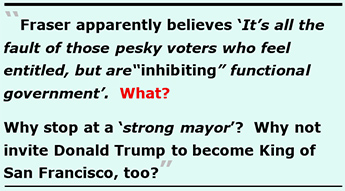
Fraser apparently believes “It’s all the fault of those pesky voters who feel entitled, but are ‘inhibiting’ functional government”? What?
Why stop at a “strong mayor? Why not invite Donald Trump to become King of San Francisco, too?
 Quixote’s Delusional Quest
So far, the Streamlining Task Force has been on a delusional odyssey to weaken commission oversight of City government and impose a system of effectively broken boards and commissions, which potentially opens the door to more corruption, more mismanagement, more ethical lapses and more departments acting outside of legal limits in our City.
San Franciscans must fight back. We must insist: “No Kings!”
Monette-Shaw is a columnist for San Francisco’s Westside Observer newspaper, and a member of the California First Amendment Coalition (FAC) and the ACLU. He operates stopLHHdownsize.com. Contact him at monette-shaw@westsideobserver.com.
An Afterthought …
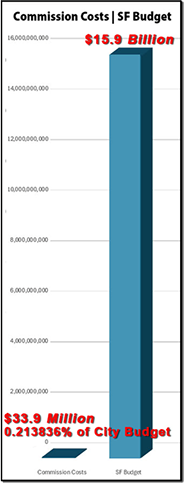
Although the proponents and backers of “Prop. D” — including Kanishka Cheng herself — wailed bitterly about the excessive costs of San Francisco’s Boards and Commissions, the five-member Commission Streamlining Task Force only heard mention once about any costs during their first four, body-by-body discussions of each of the 150 boards and commissions on their list of bodies.
And that single mention was made in passing by Rachel Alonso, the City Administrator’s Project Director providing administrative support to the Task Force during a single presentation.
Here we are just days away from their fifth and final body-by-body discussion meeting on November 5 to decide the initial fates of the final 23 remaining bodies in the “General Administration and Finance” policy area category, but unfortunately the Budget and Legislative Analyst’s (BLA) August 20 scheduled formal presentation was cancelled, and ostensibly just postponed. The BLA’s “Financial Analysis Report” was never rescheduled or presented to the Streamlining Task Force. No questions about it were ever asked, or answered.
The task force plowed through deciding to eliminate at least 65 bodies, never once having heard from the BLA — and never hearing the BLA acknowledge that he had not done an actual “cost–benefit” analysis about what value any of the bodies brought to San Franciscans.
The BLA’s report documented that costs of operating San Francisco’s approximately 112 Board and Commission policy bodies he assessed (without assessing 35 other bodies presumed to have been “inactive,” plus 7 bodies the BLA may not have known about) represented an infinitesimally, imperceptible small cost of City governance. The $33.9 million in total costs the BLA came up with represents a mere two-tenths of one percent — yes, just 0.2138% — of the $15.9 billion FY 2024–2025 City Budget.
Efforts still underway to eliminate or combine Commissions represented a penny wise, but pound foolish, quibbling fishing expedition!
Again, the $2.85 million in “soft costs” eliminating the 65 bodies identified so far likely won’t materialize, because those employees will still perform their other job duties. At best, there may only be $105,482 in “hard costs” savings from eliminating 65 boards and commissions. That’s pathetic. And laughable, because it represents just 0.31% of the total $33.9 million — or more ridiculously, just 0.00066% of the City’s $15.9 billion city budget for the current fiscal year. Yes, just sixty-six hundred-thousandths of one percent. Yes, laughable, suggesting someone’s panties had been tied in a knot,