 April 30, 2026
April 30, 2026
Careful Who and What You Vote for on June 2
Billionaire Ballot Blitz: Big Money Targets June Election (Again)
Beware Billionaires Buying Ballot Measures and District Supervisors
Money Goes In. Favors Come Out.
by Patrick Monette-Shaw
A crop of billionaires — including Michael Moritz, Chris Larsen, Bill Oberndorf, and Gary Tan, along with Mayor Lurie as an heir to a billionaire family — apparently believe San Francisco’s June 2 and November 3 elections are for sale. They’re channeling millions into so-called independent expenditure committees, most noticeably GrowSF and Neighbors for a Better San Francisco. Again.
San Franciscans know both elections aren’t for sale. They belong to the people of San Francisco, who hopefully won’t be fooled. Again.
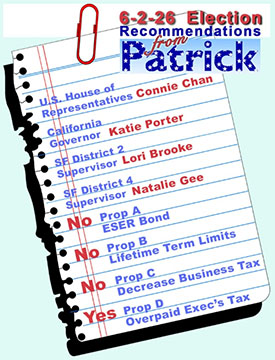 Local Ballot Measures
Thankfully, the June 2 primary election has just four measures on San Francisco’s ballot, one of the shortest ballots in a long time!
Proposition A
Formally titled “Earthquake Safety and Emergency Response Bond” (ESER), Proposition A is a general obligation $535 million bond measure that is a boondoggle, at best It relies on misinformation from the bond’s proponent, Mayor Daniel Lurie.
Of the five categories of projects listed in the Legal Text in the Voter Guide, notably missing is any funding for turning back on San Francisco’s “Outdoor Public Warning Siren” (OPWS) system. That alone justifies voting against this bond measure!
As well, the Voter Guide says repeatedly in Section 14, “CEQA,” of the Legal Text for “Prop. A” that all of the project 00categories to be funded by the Bond listed in Section 3, “Proposed Program” are not subject to CEQA, “because the establishment of a government financing mechanism that does not involve any commitment to specific[named] projects to be constructed with the funds is not a project as defined by CEQA and the CEQA Guidelines.” No named projects, no CEQA needed.
How convenient! A built-in Catch 22: That by not naming specific projects to be funded by the Bond, they could all be deemed exempt from CEQA review, and specific project decisions can be made after voters approve the entire Bond!
Apparently, specific Bond projects will only be named and subject to approval upon completion of planning and any further environmental review under CEQA — at the time tranches of the Bond are submitted sequentially to the Board Supervisors for approval years after the Bond passes. This is another great reason to vote “No”!
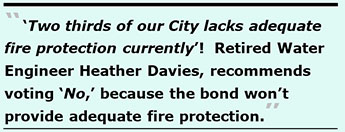 As one astute paid argument in the June 2 voter guide noted, “Two thirds of our City lacks adequate fire protection currently”! The author, retired Water Engineer Heather Davies, recommends voting “No,” because the bond won’t provide adequate fire protection. She says make the City come back in November with a better plan, to then say “Yes” to protect our future Auxiliary Water Supply System (AWSS).
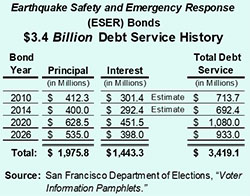
As shown in the table, the proposed “Prop. A” bond — if passed — will push San Francisco’s ESER bonds issued since 2010 to a total of $1.97 billion in principal plus $1.4 billion in interest, for a total of $3.42 billion in debt service costs. What will we have gotten from $3.4 billion for earthquake and emergency safety over the past 16 years?
 A more detailed Westside Observer analysis reveals the $535 million ESER bond in 2026 provides only $130 million (just 24.3%) will be allocated between the Emergency Firefighting Water System (EFWS) and the high-pressure AWSS. Fully $405 million (75.7%) is allocated for projects that have next to nothing to do with earthquake safety and emergency response in the event of disasters. The $405 million includes $205 million (38.3%) set aside for police, firefighter, and other public safety facilities, and a whopping $200 million (37.4%) earmarked for the MUNI Potrero Yard bus storage facility (which voters rejected before).
But sadly, spending on each of these categories will be reduced if the Bond is passed, because there was no mention in the voter guide about the costs for issuance of the bonds, and oversight and accountability costs, which have averaged $7.74 million for each of the first three ESER bonds, signaling poor truth-telling before asking voters to pass this new Bond.
Looking back further, our analysis shows that over the first three ESER bonds voters already passed for a total of $1.44 billion, just $309.6 million (21.4%) was allocated to the AWSS and EFWS systems, just over one-fifth of the three bonds. Our analysis was based on a Department of Public Works December 2024 quarterly report about the three ESER Bonds.
Fully $1.1 billion (77% of the $1.44 billion total) was allocated for various “facilities,” including $141.7 million (9.8%) to miscellaneous facilities such as Kezar Pavillion in Golden Gate Park, the Chief Medical Examiner’s new offices, and the 9–1–1 Call Center on Turk Street; $549.9 million (38.2%) was allocated for police stations, the new police headquarters, and the police Traffic Company and Forensic Services Division; and $418.4 million (29%) was allocated for neighborhood fire stations. Another $23.2 million ($1.6%) went for oversight, accountability, and costs of issuing the three bonds.
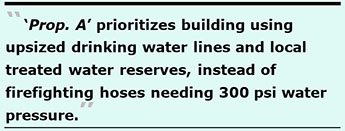
Ms. Davies, the voter guide author and water expert, wrote “Prop. A” prioritizes building using upsized drinking water lines and local treated water reserves, instead of firefighting hoses needing 300 psi water pressure. That would put San Franciscans at additional risk of not having an adequate supply for both firefighting and drinking water, and introduces adding cyber security risks — the same type of risk subject to hacking that had shut down the City’s “Outdoor Public Warning Siren” (OPWS) system in 2019! This worsens Lurie’s lie “Prop. A” will strengthen high-pressure water lines and hydrants!
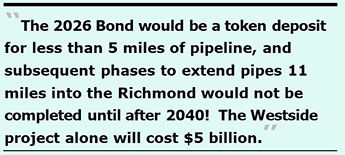
Davies notes the 2026 Bond would be a token deposit for less than 5 miles of pipeline, and subsequent phases to extend pipes another 11 miles into the Richmond and add pump stations would not be completed until after 2040! She asserts that overall, the Westside project alone will cost $5 billion (based on SFPUCs 2021 Concept Plan). She noted bond interest would double that.
 Who are you going to believe? Lurie and his billionaire friends supporting GrowSF’s voter guide that recommends passing “Prop. A”? Or a water expert who knows what’s she’s talking about?
More on Proposition A
You may be interested in a recap of additional commentary about “Prop. A” provided by two of my Westside Observer colleagues.
In the April 2026 Westside Observer issue, Geoge Wooding wrote a great article about “Prop. A” noting San Franciscans shouldn’t be fooled by the bond’s branding, promising it funds emergency safety. Wooding observed voters should ask and demand to know where the money is going, noting the bond doesn’t clearly identify what projects it will finance. Instead, voters are being asked to approve broad spending categories and incomplete project lists.
 [The CEQA Catch-22 exemptions noted above explains why there isn’t a complete project list!]
Wooding noted the MUNI Potrero Yard transit component — which voters refused to approve bond financing on before — doesn’t belong in this earthquake bond. He observed “Prop. A” looks less like a public-safety measure and more like a slush fund wrapped in the language of emergency response. He believes voters should reject the June bond, and make the City come back with a better measure for the November ballot.
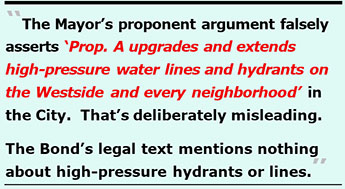
In the same issue, John Crabtree also wrote a terrific article, noting Mayor Lurie’s “Prop. A” official proponent ballot argument contains multiple inaccuracies and prevarications. Crabtree asserts the mayor’s argument supporting the bond raises one claim that is among the most egregious examples of misleading language supporting the bond measure. The Mayor’s proponent argument falsely asserts:
“Strengthening San Francisco’s emergency firefighting water system, Prop. A upgrades and extends high-pressure water lines, hydrants, and key connection points to improve reliability and coverage on the Westside and every neighborhood in every corner of San Francisco.”
As Crabtree noted, that’s deliberately misleading and fundamentally anti-democratic precisely because the legal text of the Bond in the Voter Guide mentions nothing about hydrants or high-pressure water lines.
In an earlier article in February, Crabtree noted that in the 16 years since the PUC took over the AWSS hydrant system from the Fire Department in 2010, the SFPUC still hasn’t produced a coherent plan for any of the 15 unprotected neighborhoods on San Francisco’s West Side he named. He also noted that the first of three ESER bonds was passed by voters the same year, in 2010. Over those 16 years, Crabtree reported not a single AWSS hydrant has been installed in any of the 15 neighborhoods.
 Crabtree reported there are approximately 9,000 white-topped, low-pressure hydrants across the City that are supplied by domestic drinking water mains. And then there are about 1,600 hydrants that are supplied by the high-pressure water mains of the AWSS that have red, blue, or black tops.
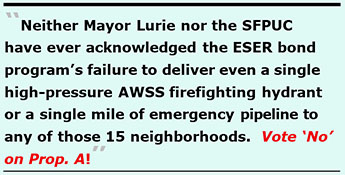
But notably, neither Mayor Lurie nor the SFPUC have ever acknowledged the ESER bond program’s failure to deliver even a single high-pressure AWSS firefighting hydrant or a single mile of emergency firefighting pipeline to any of those 15 neighborhoods. That may be because after the ESER bond measure passed in 2014, the SFPUC announced the City no longer planned to extend the AWSS into those neighborhoods. That’s what happened after the Fire Department lost control of the firefighting system plans in 2010!
The June 2026 ESER Bond doesn’t mention extending the high-pressure AWSS hydrant system into unprotected neighborhoods, despite Lurie’s lie in his Proponent Argument that the bond will upgrade and extend the high-pressure water lines and hydrants. Crabtree concluded his April article noting San Franciscans will start trusting City Hall again — when City Hall stops lying to us.
Vote “No” on Prop. A! Tell the Mayor to try again harder in November!
Proposition B
Formally titled “Lifetime Term Limits for Mayor and Members of the Board of Supervisors,” Prop. B is a Charter Amendment. It’s clearly a solution in search of a problem! It was first introduced at the Board of Supervisors by first-term District 5 Supervisor Bilal Mahmood on December 16, 2025. Mahmood was heavily backed by the Astroturf Network group “GrowSF” when as a carpetbagger he was elected to the Board of Supervisors in November 2024. It was eventually placed on the June 2 ballot by a vote of 7–4 of the Board of Supervisors. They included supervisors Bilal Mahmood, Matt Dorsey, Myrna Melgar, Danny Sauter, Stephen Sherrill, and Alan Wong.
It’s clear they did so attempting to manipulate the electoral process, and make it easier for themselves and their friends to win elections. They’re playing a corrupt political insider’s game!
Oddly, the “Prop B” official proponent argument in the Voter Guide was written by Adrianna Zhang, a Stanford University public policy student and former chair of the San Francisco Youth Commission, not by members of the Board of Supervisors. The co-presidents of the San Francisco Young Democrats club also signed on as official proponents. Why is a public policy student and Youth Commissioners official proponents to amend the City Charter?
The billionaire- and tech-backed “Astroturf Networks” GrowSF and Neighbors for a Better San Francisco have both contributed significant donations in support of “Prop. B” to undermine voices of San Franciscans.
The official opponents of “Prop B” in the Voter Guide include former Mayors Willie L. Brown and Art Agnos; former Judge, State Senator, and Supervisor Quentin Kopp; former State Senator and Supervisor Mark Leno; former Assemblymember and Supervisor Tom Ammiano; and former supervisors, Michela Alioto-Pier, Bevan Dufty, Sandra Lee Fewer, and Norman Yee. All nine of them urge San Franciscans to vote “No on B.”
Former Governor Jerry Brown has condemned the Charter Amendment that would impose lifetime term limits on city supervisors and mayors, calling it “Trumpian” and anti-democratic. Apparently, supervisors Mahmood, Dorsey, Melgar, Sauter, Sherrill, and Wong are OK with their Trumpian handiwork!
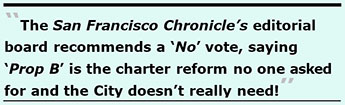 Even the San Francisco Chronicle’s editorial board recommends a “No” vote, saying “Prop B” feels like insider politics, not effective governance. The Chronicle asserted “Prop B” is the charter reform no one asked for and the City doesn’t really need. Hear, hear!
“Prop. B” barely has a pretense of propriety.
Weirdly, “Prop. B” specifically includes a carve-out to protect current Supervisors Sherrill and Wong. It provides that if they are re-elected to their District 2 and District 4 seats, respectively, at the election on June 2, 2026 they may complete the term of office for which they were elected, regardless of whether their holding the office would otherwise violate the lifetime term limit. Why is this carve-out necessary? No wonder they voted to place the measure on the June ballot: More Trumpian self-interests!
Even more weirdly, “Prop. B” is selectively excluding placing lifetime limits on San Francisco’s other elected officials, including the Assessor-Recorder, City Attorney, District Attorney, Public Defender, Sheriff, and Treasurer. The selective exemptions to lifetime term limits couldn’t be more Trumpian!
And in similar twist, Mayor Lurie’s Commission Streamlining Task Force has proposed that for his planned November commission reform Charter Amendment, all appointees to boards, commissions, and policy advisory bodies will be allowed to serve for terms of up to 12 years. It’s another carve out that makes eight-year term limits for members of the Board of Supervisors even more inexplicable.
As noted in paid arguments in the “Prop. B” in the Voter Guide, only one City leader in 30-plus year has returned after the required four-year break between two successive terms since term limits were enacted in San Francisco in 1990: Former Supervisor Aaron Peskin, who represented District 3 from 2001 to 2009 and from 2015 to 2025, chose to run for elected office again. It’s clear “Prop. B” was deliberately written to prevent a progressive like Peskin from mounting another campaign to represent District 3!
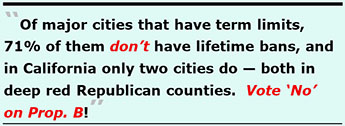 Of major cities that have term limits, 71% of them don’t have lifetime bans, and in California only two cities do — both in deep red Republican counties. San Franciscan’s shouldn’t adopt Republican anti-democratic shenanigans!
As Judge Kopp rightly notes, a lifetime ban is extreme and unnecessary. It’s also an undemocratic cap. If an elected leader who earned prior, seasoned experience chooses to run again after a required four-year break in service, San Franciscans shouldn’t have their voter choices artificially limited. If San Franciscans choose to return an experienced leader to office, we deserve voter choice. The current system has worked fine for the past three decades and isn’t broken, so it doesn’t need to be “fixed.” Vote “No” on Prop. B!
Proposition C
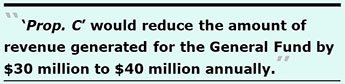 Formally titled “Decreases to Business Taxes,” Prop. C is a voter initiative that qualified for the ballot. Its proponents are Rodney Fong, CEO of San Francisco’s Chamber of Commerce, and Chris Wright, a Senior Vice President of the advocacy group Advance SF. It’s application to circulate signature petitions initially titled their proposal as “Small Business and Economic Recovery Act.” According to the City Controller’s statement in the Voter Guide, Prop. C would reduce the amount of revenue generated for the General Fund by $30 million to $40 million annually, by increasing the small business exemption ceiling threshold for businesses with gross receipt revenue from $5 million to $7.5 million, therein exempting more small businesses from the tax and essentially moving the goalposts for smaller businesses.
Thanks in part to San Francisco’s Chamber of Commerce, the $40 million annual General Fund shortfall noted by the City Controller will be created by increasing the number of businesses exempted from the tax, handing these mid-size companies a massive tax break.
All eight of the paid ballot arguments in support of “Prop. C” in the Voter Guide were paid for by a recipient campaign committee named “Protect San Francisco’s Small Business and Economic Recovery, by San Francisco Civic Organizations.” The committee’s three largest donors include Michael Moritz and Chris Larsen — who are not “civic organizations.” They’re billionaires!
After voters first approved the “Gross Receipts Tax” by “Proposition E,” in November 2012, the Board of Supervisors passed an Ordinance in September 2014 creating a “Small Business Exemption” in Section 954.1 of Article 12-A-1 of San Francisco’s Business and Tax Regulations Code, exempting business entities earning less than $1 million in gross receipts from the tax. Over the years, the exemption was raised from $1 million, to $5 million, and now the billionaire backers are trying to raise the exemption to $7.5 million, which essentially grants the exemption to larger companies that are essentially not “small business.”
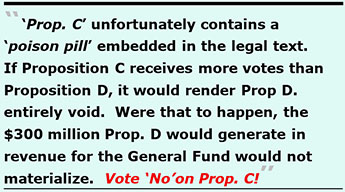 But far worse, “Prop. C” unfortunately contains a “poison pill” embedded in the legal text included in the Voter Information Pamphlet. Section 6, titled “Effect of Other Measures on the Same Ballot,” stipulates that it is being presented as an alternative to any and all other ballot measures on the same ballot that would regulate “overpaid executive taxes,” which apparently includes “Proposition D.” If Proposition C receives more votes than Proposition D, Prop. C would essentially nullify and render Prop D. entirely void. “More votes” is defined as “greatest number of affirmative votes” — even if Prop. D also passes. Were that to happen, the $300 million Prop. D would generate in revenue for the General Fund would not materialize, in addition to the loss of $40 million in tax breaks for medium-size businesses. Vote “No” on Prop. C!
Proposition D
Formally titled “Increases to Business Tax Based on Comparison of Top Executive’s Pay to Employees’ Pay,” Prop. D is a voter initiative that would increase the “overpaid executive tax” San Francisco voters passed with “Proposition L” in 2020. It would apply only to corporations with over $1 billion in revenues, have more than 1,000 employees, and whose executive managers earn over 100 times the pay of their worker’s median salaries. It asks large corporations, not small businesses, to contribute more. According to the City Controller’s statement in the Voter Guide, Prop. D would increase the amount of revenue generated for the General Fund by an additional $250 million to $300 million annually, by increasing the existing “overpaid executive tax.” It wouldn’t cause businesses to leave the City.
 It’s only fair to offset the massive tax breaks the Trump Administration handed out with the “One Big Beautiful Bill” that decimated Federal funds being awarded to San Francisco by passing Prop. D! Contrary to initial fears in 2020, business stayed in San Francisco following passage of “Prop L,” and didn’t flee The City!
Prop. D is supported by a supermajority of San Francisco’s Board of Supervisors, and Supervisors Bilal Mahmood and Chyanne Chen signed a voter guide argument supporting Prop. D, despite the fact that Supervisor Matt Dorsey signed the official Opponent Argument in the voter guide.
Of the 11 paid arguments in the voter guide against Prop. D, centimillionaire Gary Tan, the former CEO of “Y Combinator” signed one of the arguments against, and billionaires Michael Moritz and Chris Larsen were the two largest contributors to the ten ballot arguments paid for by the “Protect San Francisco’s Small Business and Economic Recovery” recipient committee. There’s Moritz and Larsen again, throwing their money around again to buy outcomes of ballot measures! As well, the Astroturf Network groups “Advance SF” and “Connected SF” are also opposing “Prop. D”!
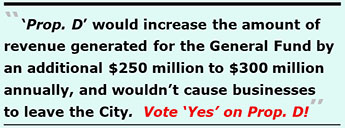 Given San Francisco’s purported current billion-dollar deficit over the next three years, don’t be fooled and misled by Silicon Valley billionaires, and their cheerleader — billionaire-heir Mayor Daniel Lurie. Vote “Yes” on Prop. D!
Elected Office Candidates
This article focuses on just four contests for elected office. All four races involve heavy spending by billionaires, given the U.S. Supreme Court’s “Citizens United v. Federal Election Commission” decision in January 2010.
United States Reresentative in Congress, District 11
The race to replace House Speaker Emeritus Nany Pelosi, the June 2 election is actually a primary, which will advance the two highest vote getters to the November 3 run-off election.
Saikat Chakrabarti has never held elected office. He shouldn’t replace Pelosi, given his lack of any legislative experience.
As for Scott Wiener, his current TV ad campaign claims electing him will “make government work for us.” Given his history, how does he assume he is part of “us”? His ads also assert he has “streamlined building tens of thousands of homes,” which is a wild exaggeration of his accomplishments. In fact, Wiener’s legislative accomplishments in the California Senate — SB 35, SB 79, SB 677, and SB 828 — have “streamlined” giving developers massive tax breaks that has resulted in little new housing having been built in San Francisco. His legislation has effectively taken away local control of land use planning and handed that authority to the State.
He’s pushing the dream of “homeownership” to the 66% of San Franciscans who are renters. Wiener’s TV ads feature his nickname of “Giraffe” feeding a giraffe at a zoo, to appeal to voter’s softer sides. His campaign mailers assert he’s passed laws to make it easier to build in California, and claims he has plans to build 8 million homes to fix our broken housing system if he’s elected to Congress. We don’t need a giraffe in Congress; it’s already too much of a zoo!
The last thing San Franciscans need is a destructive and divisive force like Wiener in Congress. GrowSF and Lurie’s billionaire backers are supporting Wiener’s bid to replace Pelosi. That support needs to be stopped on June 2!
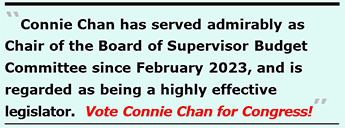
Supervisor Connie Chan was first elected to the Board of Supervisors in November 2020 and reelected in November 2024. She has served admirably as Chair of the Board of Supervisor Budget Committee since February 2023, and is regarded as being a highly effective legislator.
0San Francisco needs to replace Pelosi with another woman in the House of Representatives! Vote for Connie Chan on June 2! Send her to the general election in November.
California Governor
The crowded field for California’s next Governor in the June 2 election is also a primary election, which will advance the two highest vote getters to a run-off in the November 3 general election.
Billionaire Tom Styer has never held elective office, and although he has transformed into being a progressive voice, he has never held elective office and has never authored legislation. He’s reportedly blown through spending $120 million of his personal fortune to buy his first election.
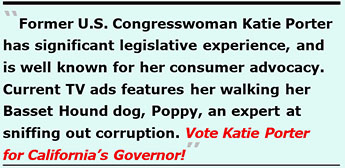
By contrast, former U.S. Congresswoman Katie Porter has significant legislative experience. She wouldn’t be running for governor, were it not for now U.S. Senator Adam Schiff having endorsed Republican Steve Garvey in the 2024 primary election to replace Senator Diane Feinstein, who had passed away. Schiff had faced having tocompete against Porter in the then 2024 November run-off election. Fearing he would lose to a woman, Schiff unethically endorsed Garvey so he wouldn’t have to lose to Porter in the runoff election. It was the most callous thing Schiff ever did!
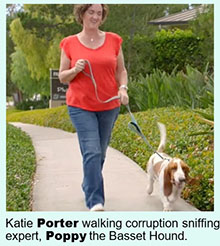 Porter is well known for her consumer advocacy, and use of a “white board” to challenge public- and private-sector officials. One of her current TV ads features her walking her Basset Hound dog, Poppy, an expert at sniffing out corruption from a mile away. It’s long past time for California to have a female Governor!
Let’s elect California’s first woman governor. Vote for Katie Porter in the June 2 primary, to send her to the general election in November. Let’s send Katie and Poppy to Sacramento!
San Francisco Board of Supervisors District 2
District 2’s current supervisor, Stephen Sherrill, is an ally of Mayor Lurie. Sherill is backed for election by GrowSF and the Astroturf Network billionaire boys. Sherrill voted to place “Prop. B,” the “Lifetime Term Limits” measure on the Novembers ballot to please Lurie’s billionaire backers.
Former Mayor Breed appointed Sherrill on December 18, 2024, to the Board of Supervisors to serve out the rest of D-2 Supervisor Catherine Stefani's term. No wonder Sherrill is supporting “Prop. B,” to gain the carve-out to serve his two-year appointed term, in addition to the proposed lifetime eight-year term limits!
Sherill’s challenger is Lori Brooke. Booke is co-founder of Neighborhoods United SF (NUSF), a growing coalition of long-established neighborhood, business, and civic organizations across San Francisco that are deeply concerned about the proposed height increases (upzoning) across San Francisco (brought to us ny non-other than State Senator Scott Wiener). NUSF’s coalition is comprised of 60 neighborhood, tenant, small-business, and housing groups across the city to advocate for more affordable housing.
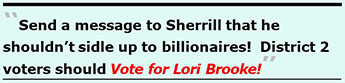 Predictably, the billionaire-backed GrowSF has endorsed Stephen Sherrill rather than Brooke, because Lori doesn’t support Mayor Lurie’s “Family Zoning Plan” and doesn’t support building more market rate housing; she gets it that the City needs to focus much more on building affordable housing, instead.
Send a message to Sherrill that he shouldn’t sidle up to billionaires! District 2 voters should Vote for Lori Brooke.
San Francisco Board of Supervisors District 4
Current District 4 Supervisor Alan Wong wasn’t elected by the will of D-4 voters. He landed the gig by cozying up to Mayor Lurie, and is essentially doing the mayor’s bidding following his appointment to the Board by Lurie last December. Don’t be fooled by Wong’s tepid approach to reopening the Great Highway for his Sunset voter constituency, or his anemic push to have the emergency Outdoor Public Warning System sirens re-activated for tsunami-prone coastal residents of D-4.
And don’t forget Wong went along to get along with the Astroturf Networks pushing the lifetime term limits proposed in “Prop. B.” Wong is again being backed by GrowSF and the boys in Astroturf Networks to further Lurie’s agenda.
 By contrast, D-4 candidate Natalie Gee is Chief of Staff to District 10 Supervisor Shamann Walton, and has been a Legislative Aide to Walton for over seven years. She has experience in public policy and legislative development, and has drafted and helped pass major legislation. That alone qualifies her far more than Mr. Wong.
Gee has significant endorsements from labor unions, including theAmerican Federation of Teachers Local 2121, Teamsters Joint Council 7, IPTE Local 21, Union of Elevator Constructors Local 8, National Union of Healthcare Workers, and SEIU Locals 1021 and 2015. She’s also endorsed by former Mayor Art Agnos, the San Francisco Tenants Union, Chinese Progressive Association, and the Harvey Milk Democratic Club.
District 4 voters should Vote for Natalie Gee. Send the same message to Wong that he shouldn’t sidle up to billionaires!
Be sure to vote on or by June 2! Let’s stop billionaires from buying ballot measures and district supervisors!
A Test for Voters
The June 2 election is more than routine — it’s a test of whether San Franciscans will allow concentrated wealth to shape public policy.
Across ballot measures and candidate races, a consistent pattern emerges: Significant spending by a small group of wealthy individuals seeking influence.
Voters face clear choices: Reject measures lacking transparency and accountability; question proposals that reduce public revenue while benefiting private interests; and support candidates with demonstrated experience and independence.
San Francisco’s future should not be decided by millions of dollars in campaign spending. It should be determined by informed voters exercising independent judgment.
Be sure to vote on or by June 2 — and make it count. Let’s stop billionaires from buying ballot measures and district supervisors!
Monette-Shaw is a columnist for San Francisco’s Westside Observer newspaper, a member of the ACLU, and a “Democracy Watchdog” member of the California First Amendment Coalition (FAC). He operates stopLHHdownsize.com. Contact him at monette-shaw@westsideobserver.com.