 June 26, 2026
June 26, 2026
Raising Paid Ballot Argument Fees Steeply; Axing Ballot Measure’s Legal Text
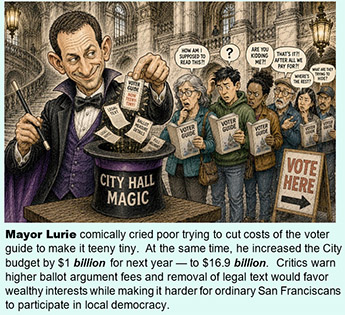
Mayor Lurie’s Plot to Neuter San Francisco’s Voter Guide
Mayor Is Again Undermining How Democracy Works in San Francisco.
San Francisco Has 778 City Employees Who Earn Over $330,000;
Eliminating One of Them Could Fund Printing Legal Text in Voter Guide!
Mayor Lurie Just Added $1 Billion to City’s Now $16.9 Billion Budget!
Cutting Voter Guide Costs Is a Sham, and a Pretext!
The Elections Department Is Not an “Enterprise Department”
Charging Customers for Services!
Proposed Legislation Was Merely Delayed and May Be Reintroduced.
by Patrick Monette-Shaw
Since Mayor Lurie took office in January 2025, his administration has tried twice to massively increase the fees San Franciscans would have to shell out to place paid ballot measure arguments in the City’s voter guide.
Both attempts fizzled out, but advocates worry he may try for “third time’s a charm.” He may well try his gambit again, soon.
Of note, neither time have City staff presented an analysis of which constituents have been placing paid arguments in the voter guide, although the Department of Elections surely could produce that data.
 Mayor Lurie has proposed a $16.9 billion City budget for the fiscal year starting July 1, 2026 — which is a billion-dollar increase over the previous fiscal year budget about to end. Are we to believe Lurie needs to eliminate $330,000 — just 0.001953% of the entire proposed City budget — for printing the legal text in the voter guide? Yes, a mere nineteen-hundredths of one percent.
Consider this: As of June 30, 2025 San Francisco had 778 City employees on the City payroll who earned over $330,000 in total pay, at a whopping cost of $305 million. Eliminating one such employee could easily fund printing the legal text. It’s just a matter of misplaced priorities!
An analysis by the Westside Observer reveals that had the increased fees been implemented, between the November 5, 2024 and June 2, 2026 elections individuals and smaller non-profit-, neighborhood-, and tenant-organizations, plus civic groups, would have had to pony up an additional $27,200 for the 34 ballot arguments they placed in the voter guide, on top of the $6,800 they had actually paid out just for the placement fees (excluding per-word fees) — which they likely could not have afforded, and their voices would have vanished.
By contrast, the billionaire-funded candidate-, ballot measure-, and independent recipient-committees, along with billionaire-funded business PAC’s, Astroturf Network PAC’s, and labor unions could have easily raised the increased $181,600 for the 227 ballot measure argument submission filing fees they had paid just $45,400 for. The billionaire class could have easily paid for $227,000 in fees to San Francisco’s Elections Department to make their voices heard, had the fees been implemented!
Individuals and small organizations would have been priced out, silenced.
As the Mayor lurches toward getting his favorite four (or more) City Charter reform ballot measures on next November’s ballot passed, he just tried to gin up and fast-track getting fee increases enacted again by the Board of Supervisors through unilateral fiat.
If this sounds vaguely Trumpian, that’s because it is — coming from our billionaire heir, the Mayor, via his Budget Director.
He tried having his staff sneak undemocratic changes through the Board of Supervisors on June 17 to keep us — lowly pesky voters — from being involved in the process as much as possible.
Lurie didn’t want to bother voters’ pretty little heads about three major changes to City policy involving San Francisco’s official “Voter Information Pamphlet” (VIP), a.k.a., our “Voter Guide”: Per-word fees, per-argument fees, and eliminating the granular legal text describing ballot measures voters are asked to pass.
As my Westside Observer colleague, John Crabtree, testified to the Board of Supervisors on June 17:
“It appears the Mayor had simply been trying to soften the electoral ground in advance of his Charter ‘reform’ and Commission ‘streamlining’ efforts on the November ballot this fall, and to otherwise sweep away democratic processes and bar opposition voices from the ballot via sweeping autocratic legalism dressed up as budgetary ‘savings’ and electoral ‘reforms.’ ”
I’d only add that Lurie appears to have expected his subservient Board of Supervisors to do the dirty work for him. Fortunately, the Board of Supervisors said, “no dice, not on our watch”!
Initial Voter Guide Fee Increases Failed
Last December 10, 2025 the Board of Supervisors Budget and Finance Committee considered an Ordinance from San Francisco’s Director of the Elections Department, John Arntz, who first proposed amending the Municipal Elections Code to reduce the impact on the General Fund in publishing paid ballot measure arguments in the VIP. Arntz submitted it on May 9, 2025 — without any Supervisors as co-sponsors — and it was assigned to the Board’s Budget and Finance Committee under the Board’s 30-Day Rule. Had it passed, like any other Ordinance, it would likely have gone into effect 31 days later.
What was then at stake involved exorbitant fee increases for placing paid ballot arguments in the Voter Guide mailed to all registered voters in San Francisco.
There it languished for seven months until it was calendared for the December 10 hearing. Arntz proposed increasing the paid ballot argument submission fee from $200 to $1,000 per argument, plus increasing the per-word fee from $2 each to $10 per word, in one fell swoop. Left unsaid was both fee escalations involved a 400% change increase.
Arntz claimed the two fee increases would enable his Department to increase “recovery” to a greater share — from 17% to 86% — of production costs for paid ballot arguments, of actual typesetting, printing, and mailing costs. He also asserted that to “more fully” capture all publication costs, the fee increases would ideally need to be set closer to $1,100 per argument submission and $12 per word, which would have represented close to a 500% change increase!
Perhaps anticipating blowback, Arntz acknowledged that the Department recognized the proposed fees would be substantially higher than the current fees, and the Department was seeking to reduce the impact on voters who may want to have an argument published in the VIP.
 I was only San Franciscan and only member of the media to submit written testimony last December opposing the proposed fee increases, which I signed as a Westside Observer columnist. I testified, in part, that in 2008 I had submitted a paid 295-word voter Guide argument that cost me a total of $790 I had paid out of my own savings, noting that Arntz’s fees increases would have raised my costs to $3,950, a $3,160 increase. At $3,950, I wouldn’t have placed the voter guide argument, and my “Joe-the-Plumber” voice would have been silenced. Had Arntz’s preferred higher full cost-recovery fees ($1,100 per argument, $12 per word) been adopted, it would have cost me an additional $690, for a total of $4,640 — a 487.3% change increase!
Luckily, the Budget and Finance Committee didn’t buy Arntz’s gambit. Near the end of the December hearing Budget Chair Connie Chan said that the Elections Department had at the last minute requested the item be continued to the “Call of the Chair,” given the fact that it would be a significant increase to the ballot argument fees. Chan said:
“We should have further discussion, in addition to this public hearing here. I think that the Department of Elections, realizing and recognizing more work needs to be done, or more public conversation needs to be had, before we decide on the fee increase.”
With that, Chan moved to place Arntz’s proposed Ordinance to the “Call of the Chair,” essentially curtailing the proposed fee increase. Sadly, it was resurrected six months later by the Mayor’s Budget Director in June 2026, just over a year since the anti-democratic fees increases first surfaced in 2025. No additional work, or public conversation, has been undertaken since 2025.
Kittler’s Try, Try Again
Fast forward to June 1, 2026 when Kittler, as the Mayor’s Budget Director, submitted to the five-member Budget and Appropriations Committee a 29 -item “trailing legislation” memo supporting the Mayor’s proposed City budget for Fiscal Year 2026–2027 set to begin July 1. The 29-item packet resurrected both fee increases for paid arguments in the voter Guide in a new proposed Ordinance. Try, try again!
Instead of both fee increases kicking in, in one fell swoop, the Mayor’s resurrected wish proposed staggering the increases over a four-year period, beginning in July 2027, with the final increase in July 2030, perhaps to lower the sticker shock.
Somewhat shockingly, for good measure, Kittler tossed in a second Ordinance, proposing to eliminate publishing the legal text for each ballot measure from the VIP — effective 31 days following Board of Supervisors passage of the Ordinance. That was a real shocker, because San Franciscans hadn’t been forewarned such a proposal was forthcoming, and didn’t know it would be rushed through the Board of Supervisors in the absence of a 30-Day hold waiting period.
 If eliminating publishing the legal text were to have gone into effect for the November 2026 mid-term general election, the legal text for all proposed ballot measures — including the Mayor’s four planned Charter Amendments involving commission streamlining, and other government reforms handing the Mayor expanded powers — would have vanished from the mailed voter guide without any public discussion, leaving voters in the dark about what they would be voting on.
Also for good measure, Kittler tossed in submitting a 30-day hold waiver request memo on June 1 to skirt the Board’s 30-Day Rule, rushing the two Ordinances through without citizen oversight. Board President Mandelman dutifully fell in line, issuing Presidential Action Memo’s (PAM) on June 4 granting the 30-Day waiver on File #260603 ballot argument fees and another waiver on File #260604 regarding eliminating publication of ballot measure legal text in voter guides.
San Franciscans knew nothing about what was afoot until two weeks later, when the Clerk of the Board published the meeting agenda for the Budget and Appropriations Committee June 17 meeting agenda on Friday, June 12 — giving San Franciscans just four working days notice to prepare for the 10:00 a.m. hearing five days later.
June 17 Hearing Fee Increases Halted Again
About 6:00 p.m. on June 16 (the night before the hearing), advocates who had been in contact with Budget Chair Chan’s office indicated that she planned on pushing back the next morning against the paid ballot argument fee increases in the out-years (second, third, and fourth year), and would consider only the first installment of increases, doubling the $200 per paid argument filing fee to $400, and doubling the per-word fees from $2 to $4, effective a year from now on July 1, 2027.
Chan indicated that if the Mayor’s Office wants the out-year increases approved, they could come back each year and make their case for them, but she wasn’t inclined to approve all of the incremental ballot argument fee increases now, four years in advance.
A records request to Chair Chan’s office following the June 17 hearing revealed that approximately 15 minutes before the hearing was scheduled to begin, Kittler apparently called and gave Chan a heads up that the Mayor’s Office would open the hearing by asking to “table” the voter guide fee increases.
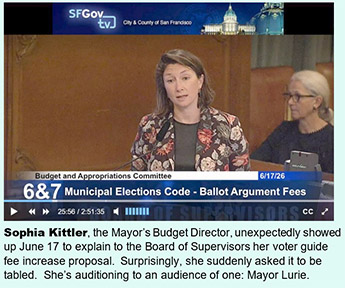 SFGOV TV videotape of the June 17 hearing revealed that Kittler spoke shortly after the hearing began (at 0:25:26 on videotape), saying:
“We’ve had some good meetings with a number of community groups and at this point the Mayor’s Office would request respectfully that you table Item Six and we will revisit at a later date.”
The Budget and Appropriations Committee hearing devolved in a flash.
It was the first members of the public learned about the sudden withdrawal of the Ordinance Kittler had submitted just 16 days earlier. Members of the public were completely caught off guard with their prepared testimony, but it’s fair to say it was a welcome relief to community members and community organizations the fee increases were being tabled, however temporarily.
Because Kittler left open the possibility the Mayor’s Office plans to revisit the paid ballot argument fees at a later date, members of the public will need to maintain eternal vigilance about the potential the fees will eventually be increased, perhaps one day soon.
With that, Chan spoke at some length and then invited Elections Director Arntz to make comments regarding Agenda Item #7 regarding publication of the legal text.
Proposal to Eliminate Legal Text
Kittler’s “trailing legislation” involved a plot to eliminate printing the legal text of each ballot measure in the VIP, ostensibly as a budgeting-cutting cost “efficiency” gambit that only a Budget Director could love. It mirrored the hubris she displayed as a Commission Streamlining Task Force member when she engineered the plot to prevent the Ethics Commission from placing ballot measures on municipal ballots.
Next up in the June 17 hearing was Mr. Arntz, who summarized his PowerPoint presentation and spoke about both the fee increases and eliminating publication of the legal text in the VIP.
The second page of his presentation asserted there has been an “historical average” revenue deficit of $341,000 over the past four scheduled elections caused by the current per-word and argument submission fees for paid arguments in the voter guide. He proposed reducing that “deficit” to just $41,000 by July 1, 2030 via jacking up the ballot argument fees incrementally by 400% over the five-year period.
Arntz, apparently like the Mayor and Kittler, apparently believe the voter guide is a cost center, with insufficient cost recovery.
Following Arntz’s introductory remarks, Chan invited her colleagues on the five-member Committee to raise any concerns about either the fee increases or eliminating publication of the ballot measure legal text in the VIP’s.
During the discussion by the Committee members, not one Supervisor bothered mentioning that San Francisco has had a 13.5% change increase in the number of registered voters over the past 13 years, growing from approximately 470,00 in June 2012 to 533,546 in June 2026. Nor did Arntz bother to mention that detail. Obviously, the cost of doing business is going to increase with the addition of 60,000 more registered voters who need the VIP’s! That doesn’t appear to have entered their minds or policy discussions.
Of interest, the SFGOV-TV caption notes reveal that Supervisor Matt Dorsey wondered if the legal text is removed from the voter guide, whether there would be a place where the legal text would be retained, to review what voters had been asked to vote on. Dorsey said, “It would give me pause on losing a phenomenal research tool about the intents of the legal text.” He added, “In my own research I often go to the library’s online version … to look at what the measure [was about] and I often find myself looking [up] the legal text.”
For his part, Supervisor Danny Sauter said he struggled a bit with removing the legal text. He claimed, “I think this is one of those things where probably the vast majority of people don’t use this [the legal text] but there’s probably 10% or 20% of the voters that really do use this.” It’s unknown whether Sauter was pulling his “10 to 20%” of voters estimate out of thin air to infer that up to 80 % of voters don’t refer to or reference the legal text — ostensibly to justify eliminating it from the voter guide. It’s also unknown whether Sauter was currying favor on behalf of Lurie and Kittler, or just carrying their water.
As well, Committee member Rafael Mandelman also seemed to be pulling data out of thin air. Mandelman said: “I do also understand $330,000 of cost savings [from eliminating the legal text] per election, and potentially more if we have, like, a special election it could easily come up to almost $1 million of savings per fiscal year.”
 But as the second Westside Observer secondary analysis illustrates, average costs of one mid-term election plus one primary election in a single fiscal year might average $614,183 — which is significantly lower than Mandelman’s $1 million estimate. And that’s ignoring that in many years (such as 2025) San Francisco holds no elections in the spring or fall!
To his credit, Mandelman said that even with the paid ballot measure argument fee increases, they would still not result in full cost recovery for the City. Also to his credit, Mandelman said:
“It sounds to me though there seems to be a building sentiment in my opinion that this Body is going to have to recognize potentially that we need to fund some of these costs so that we can ensure we’re not suppressing voters and that we’re encouraging access for information for voters.”
He said we should be supporting our “small d” democracy. Then he backtracked, as is often the case, saying:
“If you think about all of the things that we are cutting right now … for me this is a reasonable proposal to reduce City costs … I think there’s probably some things any of us would come up with as higher priorities [than the voter guide]. I think it might be time to phase this out but I also sense that my colleagues are not completely comfortable with that.”
There you have it. Mandelman is open to phasing out a key part of San Francisco democratic elections as a cost-cutting move, dressed up as “trailing” budgetary savings to please the Mayor’s Budget Director Kittler. Ms. Kittler and her hubris!
With that, Chair Chan opened the meeting to public comment.
Public Testimony Opposing Mayor’s Two Proposals
The background information files posted on the Appropriations Committee’s meeting agenda contained public testimony opposing both agenda items in a correspondence file for Agenda Item #6 and a separate correspondence file for Agenda Item #7.
Prominent San Franciscans submitted compelling reasons why the Board of Supervisors should reject both the per-paid-argument submission, and per-word, fee increases, and the elimination of publishing the legal text in the VIP’s.
For instance, longtime activist Richard Ivanhoe, who is president of the Haight Ashbury Neighborhood Council, speaking for himself (not HANC), wrote:
“In this era of voter suppression from the Federal government, why would San Francisco reduce its voters’ voices? Why rush this through? … Increasing the cost of ballot arguments means that only the wealthiest (or those with access to independent expenditure committee funds) can have their voices heard.”
The League of Pissed-Off Voters, wrote in part:
“… when people want to understand what these increasingly complicated measures do and how they will impact our communities, they turn to the full text in the voter information pamphlet for the most detailed, neutral take.
We also oppose increasing the ballot argument fees. San Francisco Elections should not be in the business of “pay to play.” Ballot arguments are an important part of our democracy, and drastically increasing these fees would restrict voices to only the most wealthy …”
 The League of Women Voters weighed in, writing:
“Fair elections depend on an inclusive process, one where the cost of participation does not determine who gets heard by the electorate. … Paid ballot arguments allow a diverse range of voices … to speak directly to San Francisco voters. …
Steep fee increases don’t affect everyone equally. Well-funded campaigns and wealthy individuals will be unaffected, while less well-resourced community-based organizations and individuals will be silenced. … A five-fold fee increase that directly affects the costs of participating in elections warrants more public input than a trailing ordinance with a waived 30-day hold allows. … Restructuring the Voter Information Pamphlet as something that must pay for itself through argument fees risks subordinating voter service to cost recovery — reorienting the document around the revenue it generates rather than the information voters need.”
Noted District 7 Neighborhood Activist Emeritus George Wooding, who has served as the president of the West of Twin Peaks Central Council, and as president of the Coalition for San Francisco Neighborhoods, wrote.
“The public needs time to digest why these items have been fast-tracked behind the public’s back. The speed of these items’ passage is breathtaking and irresponsible. … As the cost of ballot arguments will be increased by 400%, average citizens will be financially forced to stop commenting on ballot measures [in the voter guide]. This is a blatant attempt to force citizen participation off of the ballot. Only the wealthy need apply. … By not publishing legal text [in the voter guide] many citizens will not understand what they are voting for or against in granular detail.”
Notable lawyer Jean Barish, wrote:
“[The proposed Ordinance in #260604 would] … allow the Director of Elections to determine the format of the Voter Information Pamphlet without the Ballot Simplification Committee’s approval. Both these measures will weaken democratic elections in San Francisco, and will likely hand over even more power to special-interest recipient committees funded by billionaires to adversely influence San Francisco elections, further eroding the right of all voters to participate in our election process regardless of their economic status.”
Among John Crabtree’s other observations reported in this article, he also noted in his testimony:
“Neither the [Board of Supervisors] nor the [Department of Elections], nor, for that matter, the Mayor’s office appears to have considered any other potential cost savings or revenue enhancements, only a 400% increase in per-word filing fees.”
Interested readers can review the complete written testimony at the links above, and also listen to the impassioned oral testimony presented during the June 17 hearing on SFGOV TV. They were all passionate about saving democracy in San Francisco. And, of note, there was zero public testimony submitted in support of the Mayor’s plot!
Alternatives Not Explored or Considered
Mr. Crabtree was right on the money: Lurie, Kittler, and Arntz haven’t even considered potential alternative cost savings. To be helpful, here’s a few starting points:
 “Recipient Committees.” As noted, between SanFrancisco’s November 5, 2024 and June 2, 2026 elections there were a total of 261 paid arguments about ballot measures in the VIP. Individuals and smaller non-profit-, neighborhood-, and tenant-organizations, plus civic groups, placed just 34 of the ballot arguments in the voter guide.
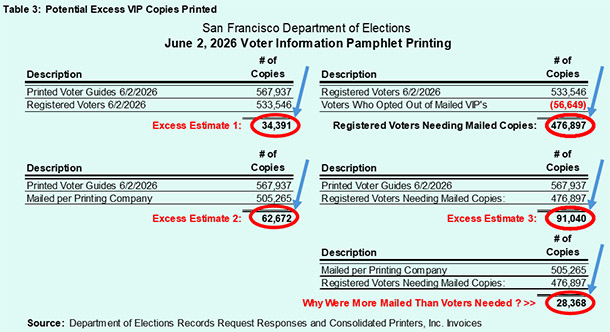 Reduce Excess Copies Printed: As the attached analysis illustrates, there appears to have been an “overage” of somewhere between 34,391, to 62,672, to 91,040 more VIP’s printed for the June 2, 2026 primay election than needed for mailing, depending on your point of view.
  After Arntz failed to provide that information, a second follow-up e-mail was sent on June 23 that more pointedly requested that because 476,897 registered voters have not opted out of receiving their VIP’s through the mail and since 567,937 VIP’s had been printed there seems to have been 91,040 more VIP’s printed than mailed. Again, Arntz was asked whether the Elections Department has a list of why it needs 91,040 extra copies printed as some sort of "surplus," and which entities receive those voter guides that are not being mailed to registered voters.
 Admission of Uncertainty
Following public comment, amazingly Director Arntz said, “I don’t know if our budget has been set to include the reduction in costs for the removal of the legal text.” It was an admission that even he wasn’t clear on whether Kittler had eliminated the $330,00 for printing of the legal text in the voter guide!
 Then, Committee Member Shamann Walton spoke, saying:
“I do believe there’s just been a lot of attempts to avoid democracy in the name of efficiency, in the name of saving resources. And I think both of these items are part of that, even with the best intentions. I mean we spend millions of dollars on many things, and I think it’s very important to protect democratic voice and that the political process continues.”
Then Chair Chan quickly moved to a roll call vote. Separate motions to table the paid argument fee increases (Item #6) as Director Kittler requested, and a motion to place elimination of the ballot measure legal text from the voter guide (Item #7) to the “Call of the Chair” to allow further conversation without other action, passed unanimously on both votes.
But strangely, in closing the hearing Chan stated the Budget and Appropriations Committee may need a “supplemental of $330,000” for the budget set to start July 1st. Why Chan suggested a budget supplemental might be necessary, after Arntz had just admitted he didn’t know if his Department’s budget was cut to eliminate publishing the legal text wasn’t explained.
That may involve whether a vacant Deputy Director is hired in the near future, which Arntz wants done, even though the Board’s Budget and Legislative Analyst (BLA) reported that position has been vacant for 13 years, since Ed Lee was mayor!
The BLA had also recommended decreasing Arntz’s printing budget by $200,000 because of underspending in other “Non-Personnel Services” in the previous two years of $2.5 million and $4.7 million that had been carried forward.
It’s not known whether Kittler incorporated the BLA’s recommendation, but her “Budget Book” shows an increase of $116,961 to Arntz’s “Non-Personnel Services” budget recommendations, not a $200,000 cut.
June 17 Hearing Aftermath
Five days after the hearing, in response to a public records request, Mr. Arntz wrote:
“The Department’s budget was reduced by $300,000 based on the trailing legislation. Subsequently the Budget and Finance Appropriations Committee placed funds [to hire] a deputy director position [in the Elections Department] on reserve in relation to the [the ballot arguments fees and elimination of the legal text] legislation not being approved.”
On June 24, Supervisor’s Chan’s office indicated the Appropriations Committee potentially placed $346,763 on reserve pending hiring, and noted that in the event the Elections Department is not successful at hiring a Deputy Director in the immediate term, Chair Chan suggested they use the money for printing the legal text in the November 2026 voter guide.
 Elections Department Isn’t a Revenue Center
It’s not clear whether it is Lurie, Kittler, or Arntz who is presuming the Voter Guide is a cost center that must break even to stay in business. It’s not as if the Elections Department is a San Francisco “enterprise department” that charges “customers” for services, and in many ways operate like a business — such as the Airport, Port Authority, and Public Utilities Commission. Voters are not customer’s buying anything from the City or expected to pay for the privilege of being able to read the legal text what they are voting on, for goodness sake!
As my Westside Observer colleague, John Crabtree has noted:
“The Voter Information Pamphlet is not a revenue source, it is a sunk cost, a vitally important one: The cost that we pay to live in a democracy vs. the less obvious price that we will all pay when that democracy is gone. Democracy has a cost, but autocracy extracts a price too, a steep price.”
In economics and business decision-making, a sunk cost is one that is typically a cost of doing business that can’t be recovered. It goes without saying that publishing the legal text in the Voter Guide of what it is voters are being asked to approve, is just a sunk cost of doing business — a cost of managing public governance! Lurie and Kittler just need to stand up and accept the costs of administering our democracy! Both should have learned that studying public policy in college.
After all, San Francisco’s elections should not be for sale, despite billionaires thinking they can buy City Hall!
Arntz summarized the impacts to the Voter Guide asserting there is an average of 46 pages of legal text included in the voter guide, based on his analysis of the last four scheduled elections he left undated. But data about the past six elections — five of which Arntz had itemized in his December 2025 election, plus the June 2 Voter Guide — reveals there has been an average of only 40 pages of legal text explaining the ballot measures, not 46.
He also asserted that typesetting and printing the legal text pages apparently averages $330,000 in costs — excluding the cost of mailing those legal text pages. In fact, one Westside Observer secondary analysis shows that average costs over the past six elections for printing, typesetting, and mailing the legal text pages only averages $298,993 (just 20% of the total average cost of printing an average 195-page complete Voter Guide). In response to a records request placed after the June 17 hearing, the Elections Department asserted its budget was reduced by $300,000, based on the trailing legislation — ostensibly after the Mayor’s “Budget Book” was published on May 30, which does not show the Voter Guide printing funds had been reduced.
However, it appeared the June 17 hearing was focused on Kittler’s budget-related “trailing legislation” that could affect whether the legal text of each ballot measure for the upcoming November 2026 mid-term election will be printed. A separate Westside Observer analysis of the average costs of publishing the legal text in VIP’s in the last three mid-term elections held in fall (November) averages $440,432. Surely Mr. Arntz knows the seasonal fluctuations involve higher average costs in November elections.
Why the average costs of printing the legal text was $440,432, but Arntz’s budget was reduced by only $300,000 based on planned elimination of printing the legal text in the November VIP, wasn’t explained.
That suggests that if the legal text is restored and published as typical this November, the Elections Department may still need an additional $142,432 — assuming Kittler had reduced Elections’ funding for the next Fiscal year starting July 1 by $300,000 based on the trailing legislation.
So, any funds placed on reserve during the Budget and Appropriations hearing on June 17 may not cover the full $440,432.
Worse, Kittler’s second Ordinance aims to strip the Ballot Simplification Committee from deciding on the format and content of the Voter Guide, in an apparent misguided attempt to reduce formatting and publication costs, and hand those decisions unilaterally to the Director of Elections without Ballot Simplification Committee oversight or approval. What any such redesign of the voter guide would entail wasn’t described, nor were any potential reduced publication cost savings estimated.
Supervisor Chan had it right in December 2025, and it still holds true: We should have much further discussion, work still needs to be done, and more public conversation must be had before the City decides on either fee increase, or eliminating publication of the legal text.
 Monette-Shaw is a columnist for San Francisco’s Westside Observer newspaper, a member of the ACLU, and a “Democracy Watchdog” member of the California First Amendment Coalition (FAC). He operates stopLHHdownsize.com. Contact him at monette-shaw@westsideobserver.com.