 September 3, 2026
Part 2: Billionaires Are Rewriting San Francisco’s Rulebooks
Voters Should Also Just Say “No on Proposition D”
Mayor Lurie Is Undermining How Democracy Works in San Francisco.
Prop D Isn't Reform. It's a Wall Around the Ballot Box.
The Name “Fix Our Broken Ballot Measure Process” Is Mayor Lurie’s Con.
The Process We’ve Had For Deacdes Isn’t “Broken”!
Who Benefits If “Prop D” Passes? Not You!
by Patrick Monette-Shaw
There is an old rule of watchdog journalism, one I have tried to live by for two decades of naming names at San Francisco City Hall: “It is a newspaper’s duty to print the news and raise hell.” Joe Fitzgerald Rodriguez, who used that tag line on his old San Francisco Examiner column “On Guard,” put it plainly — reporters have “a special obligation to serve as watchdogs over public affairs and government” and a duty to “give voice to the voiceless.” That obligation doesn’t disappear when the people in power have good branding, soft-spoken mayors, and eight-figure war chests. If anything, it matters more.
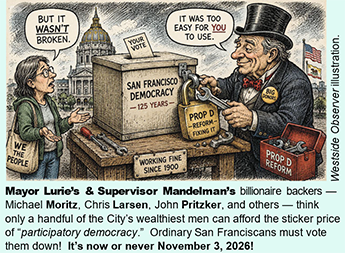
That’s the situation San Francisco voters face this November with Proposition D, Mayor Daniel Lurie’s so-called “Fix Our Broken Ballot Measure Process.” The name is a con. Our ballot measure process is not broken. What Lurie and a handful of the City’s wealthiest men are trying to fix is San Franciscans’ ability to use it.
Two Poison Pills, One Target: You
Strip away the consultant-tested branding and Prop D does two things.
First, it takes the power to place a measure on the ballot away from a minority block of the Board of Supervisors. Right now, any four of San Francisco’s eleven supervisors — representing hundreds of thousands of constituents — can put a measure before voters even when a majority of the Board disagrees. That’s not a design flaw. It’s a deliberate check that lets dissenting neighborhoods and dissenting supervisors go over the heads of a City Hall majority and ask voters directly. Prop D raises that bar from four supervisors to six, effectively requiring majority buy-in before the people even get a say. That’s not streamlining democracy. That’s silencing it — muzzling any supervisor, and by extension any neighborhood or constituency, that isn’t already in the mayor’s camp.
Second, and more consequentially, Prop D nearly quadruples the signature threshold for citizen initiative petitions, from 2 percent of registered voters to 8 percent — a 300 percent increase. Based on the current voter rolls, that’s roughly 31,000 additional signatures a grassroots campaign would need to gather just to qualify a measure for the ballot — pushing the total from around 11,000 to roughly 42,000 — at an estimated added cost of well over half a million dollars. San Francisco currently has the lowest signature threshold of any city in California. Lurie and his allies present that as a bug. I’d call it one of the last functioning features of local democracy in a city where campaign spending is otherwise dominated by a small circle of the very rich.
Do the math on who can still afford to gather 40,000-plus signatures under Prop D and who can’t. Neighborhood associations, tenant groups, library patrons, and youth advocates cannot. Tech financiers, real estate heirs, and venture capital billionaires can, easily, with a phone call to a signature-gathering firm. Prop D doesn’t fix a broken process. It builds a higher wall around the ballot box and leaves the ladder only for people who can already write seven-figure checks.
125 Years of a Right They Now Want to Take Back
San Franciscans have held the power to place initiatives directly before voters for 125 years. Prop D would strip a meaningful piece of that right away in a single election, and it asks you to believe it’s doing you a favor.Some will tell you our initiative process is too democratic — that it lets ordinary citizens vote on matters better left to bureaucrats, dredging up examples like the fight over closing the Great Highway to make direct democracy sound trivial, onerous, or unserious. I’d offer the opposite view: We’re that democratic because we believe ordinary citizens should be allowed to override bureaucrats on matters of direct concern to the public. That’s not a flaw in San Francisco’s charter. That’s the entire point of having one.
It’s worth remembering what that right has actually produced. Petition signature initiatives have raised San Francisco’s minimum wage. They’ve provided legal aid to renters facing eviction. Voter-driven initiatives banned corrupt campaign contributions from corrupt politicians, established rent control itself, and passed San Francisco’s own Sunshine Ordinance — the very open-government protections this City now struggles to enforce. They’ve helped fund our schools, our neighborhood parks, our childcare facilities, our public hospitals, and our affordable housing. None of that came from City Hall’s own initiative. It came from citizens who gathered signatures because City Hall wouldn’t act on its own.
Powerful interests have long sought to curtail that tool, for the plain reason that it works against them. San Francisco’s initiative process has delivered real gains for constituencies that powerful economic interests would rather ignore — renters chief among them. Independent analyses of SPUR’s own proposed charter reforms have found that a number of the City’s landmark tenant-protection ballot measures would not have qualified under the higher signature requirements Prop D now proposes. That is not an accident of the math. It is the math working exactly as its authors intended.
More than a century ago, the philosopher John Dewey wrote that “the cure for the ills of democracy is more democracy.” Mayor Lurie and his Prop D allies have reached the opposite conclusion: That their cure is less democracy, and less citizen involvement. Prop D wraps that conclusion in the soft language of “streamlining” and “simplifying,” but strip the euphemisms away and its purpose is to curtail participatory governance and lock out grassroots campaigns, labor unions, and community groups — not incidentally, but entirely. Direct democracy is the one tool that lets any of us put a proposal in front of our neighbors for public debate. The billionaire class funding Prop D wants that tool harder to reach. That is not reform. That is disenfranchisement with a press release attached.
Billionaires Bought Themselves a Petition Drive That’s Asking You to Trust Them
I don’t ask readers to take my word for any of this on faith — San Francisco’s own campaign finance disclosures tell the story better than I ever could.
Through July 15, an Ethics Commission’s campaign finance dashboard showed that Mayor Lurie’s own ballot-measure committee, ironically or cynically named “Clean Up City Hall,” had collected nearly $9 million reported on Form 460’s. Between July 16 and August 28, that same committee raised another $949,500 reported on Form 497’s required when receiving contributions of $1,000 or more from a single source during the last 90 days before an election. That pushed its total revenues to just shy of $10 million — slightly more than the $9.6 million raised that a similar constellation of committees raised two years ago in 2024 to put a board and commission City Charter overhaul on the November 2024 ballot (ironically also titled “Prop D”), one that voters rejected in favor of its rival measure, Prop E. Lurie’s war chest for this round is on pace to exceed that entirely, and it is likely to keep growing over the two months before election day.
Look at where the money came from. Of the committee’s largest donations, tech investor Michael Moritz gave $2 million. Ripple co-founder Chris Larsen gave $1.487 million and his wife Lyna Lam gave $1 million. Hotel heir John Pritzker gave another $1 million. In all, seven billionaires, centimillionaires, and multimillionaires accounted for the bulk of the committee’s haul. Not one of the committee’s donations was for $100 or less. Not one ordinary San Franciscan chipped in what they could afford. Lurie’s “Clean Up City Hall” committee was never a grassroots campaign. It was never meant to be. Its Lurie’s “Billionaire Big Boys’ club State Senator Scott Wiener glommed himself on to.
That money didn’t just pay for glossy mailers. It paid for the very signatures that put Prop D in front of you. The “Clean Up City Hall” committee spent roughly $4.5 million collecting about 245,000 signatures across its three charter measures — north of $18 a signature, a rate no neighborhood group or citizen coalition could ever match. As of September 1, they’ve spent a total of $5.5 million across all spending categories. The City’s next campaign finance report for Lurie’s “Clean Up City Hall” committee, due September 24, will very likely show that total climbing higher still.
Every San Franciscan should look up updated additional filings on the Ethics Commission’s public disclosure site due after September 24, or check the campaign finance dashboard page listed above, before you vote.
This is what it looks like when the wealthy write the rules for their own convenience, then ask voters to ratify the outcome as a public service. It is government reform as a luxury good — available only to those who can afford the entry fee.
SPUR’s Fingerprints Are All Over This
Prop D did not spring fully formed from Room 200. Mayor Lurie is heavily influenced by SPUR, the San Francisco Bay Area Planning and Urban Research Association, and it was SPUR’s own December 2025 “Charter for Change” report that first floated raising the petition signature threshold as a way to shrink the number of citizen initiatives reaching San Francisco voters. The idea didn’t stay confined to a think-tank white paper. It walked straight into City Hall.
Lurie hired Alicia John-Baptiste, SPUR’s former CEO, as one of his four new “Policy Chiefs” — the same positions he is separately asking voters to formally establish as “Deputy Mayors” under his companion measure, Proposition F, on this November’s ballot. Lurie is emulating his billionaire friend, former New York City Mayor Michael Bloomberg; Lurie wants to keep up with the Jones, since New York City has five “Deputy Mayors.”
Former SPUR board members Jean Fraser and Ed Harrington sat on the Commission Streamlining Task Force that produced the recommendations behind Proposition A, another charter measure on the same ballot. And Ben Rosenfield — the former City Controller who co-signed Prop D’s official rebuttal argument — currently serves as SPUR’s Senior Advisor for Governance and Economy, where his focus includes local government effectiveness, fiscal policy, and the same charter-reform agenda he writes about for the organization.
I said more about Prop’s “A,” “E,” and “F” in Part 1 of this series.
Here, the throughline is clear: “A,” “D,” “E,” and “F” are not four independent charter measures. They’re a deliberate intertwined “package” designed to share the same ballot — from one policy shop’s agenda, staffed by its own alumni, moving through four different doors at once.
Sold as Reform, Built to Concentrate Power
Lurie’s sales pitch is that San Francisco’s ballots are too long, too confusing, and too easily hijacked by dueling measures nobody asked for. There’s a kernel of truth buried in there — nobody enjoys wading through fifteen propositions written in bureaucratese. But the cure Prop D offers is worse than the disease. Raising the cost of direct democracy doesn’t make City Hall more efficient; it makes City Hall less accountable to anyone who isn’t already inside it or bankrolling it.And even taken entirely on its own terms, charter reform doesn’t touch the problems San Franciscans actually rank as urgent. Prop D won’t close a single open-air drug market. It won’t fill one vacant downtown office floor. It won’t solve MUNI’s finances, lower health care or housing costs, or boost the international tourism Mayor Lurie says he wants to revive. It does not address San Francisco’s top problems in any material way. What it does is make it harder for the people affected by those problems to force City Hall’s hand when City Hall won’t act on its own.
That’s precisely why a coalition calling itself Fair Ballot Access formed this summer to fight the measure — the first organized opposition to Lurie’s three-measure charter package. Its organizers, including Harvey Milk LGBTQ Democratic Club co-president Ajai Nicole Duncan, zeroed in on the ballot-access measure specifically, warning that they were up against enormous spending advantages just to protect ordinary San Franciscans’ voting rights. Kim Tavaglione, who runs the San Francisco Labor Council, put the practical stakes bluntly, warning that under Prop D’s new signature threshold requirements to place a measure on the ballot, initiative campaigns would face “a really high wall to climb” — one that only well-funded interests could scale. She’s right, and City Hall knows it. That’s the entire point of the measure.
A Rebuttal Built on a Falsehood
On August 20, Supervisor Shamann Walton filed an official challenge to the “Rebuttal Argument in Favor of Proposition D” signed by Lurie, Board President Rafael Mandelman, and former Controller Ben Rosenfield. Walton titled his filing “False and Misleading Statement in the Rebuttal Argument in Favor of Proposition D”; he took aim at a single paragraph, which claimed
“Opponents claim today’s rules date to 1932. The [City] Controller’s report [statement in the Voter Guide] confirms the current [signature] threshold was set in 2022, requiring approximately 9,000 fewer signatures than before. San Francisco will still have one of the lowest signature thresholds in California, including other large cities like Oakland, San Diego, and Long Beach.”
Walton called that statement false and misleading in two independent respects, arguing it falsely implies the current threshold reflects an actual reduction of roughly 9,000 signatures from a real prior requirement — a reduction Walton says the City’s own official records show never occurred. He asked Director of Elections John Arntz to strike the entire final paragraph from the rebuttal on the grounds that doing so would not interfere with printing or distributing the Voter Information Pamphlet.
At 12:47 p.m. the next day, Arntz responded in full: “After reviewing the information you provided, the Department will take no action on this challenge.” No public explanation followed. We reached out multiple times to Arntz seeking an explanation about why Walton’s challenge was denied, but received no response. We did receive a response from the spokesperson for the “No on D” campaign, Daniel Anderson, at Anderson Political.\
“It is my understanding based on the public response from Director Arntz that they will not remove the false sentence in the rebuttal argument authored by Mayor Lurie and Board President Mandelman. Based on Arntz’s letter, the Elections Department did not determine the misleading paragraph to be true,” Anderson said.
Any reasonable person would think Elections knows exactly how many signatures were required each election cycle, but simply opted not to make any change to the misleading information, without providing an explanation. That reflects badly on Arntz, acknowledging he serves as Department Head at the pleasure of the Mayor.
It’s both ironic and disturbing Lurie’s own official “Clean Up City Hall” independent expenditure committee chose to rely on misinformation in its official Voter Guide “Rebuttal” argument. That suggests lying to voters hoping for their votes is more important to billionaire funding oligarchs than actually “cleaning up” corruption at City Hall!
Make of their initial silence what you will. What’s not in dispute is that Lurie, Mandelman, and Rosenfield were comfortable putting a contested, unexplained claim into the official Voter Information Pamphlet — the one document the City guarantees will reach every voter’s mailbox — backed by a campaign that, as shown above, is firmly funded by their billionaire friends. The same rebuttal also describes Prop D’s signature increase as “a modest amount of increased signatures.” Quadrupling the requirement, adding roughly 31,000 signatures to reach a total of around 42,000, is not “modest” by any honest definition. It’s a 300 percent increase.
It may look “modest” from where a billionaire sits. For everyone else, it’s a death knell for the kind of grassroots campaigns that could ever hope to compete against billionaires. Whether Lurie, Mandelman, and Rosenfield think voters can’t do the math, or simply hope we’ve forgotten Jonathan Swift’s satirical essay about “modest,” isn’t known. The arithmetic doesn’t lie, even when Lurie’s rebuttal does.
The Controller’s Own Numbers Undercut the Case
Worse, the current City Controller’s official fiscal statement for Prop D — the analysis printed for voters alongside the measure — leans on two claims that don’t hold up.
First, it asserts that raising the signature threshold “is likely to reduce costs at levels that cannot be determined at this time,” reasoning that fewer qualifying initiatives would mean fewer printed pages in the Voter Information Pamphlet. Take a look at the actual record, which suggests the claim is just more gaslighting.
A Westside Observer analysis reveals that among the last ten San Francisco elections between 2008 and 2024 — every fall general election and spring primary across that span — only 17 voter-initiated signature petition measures made the ballot, out of 107 total ballot measures citywide.
That’s 16 percent of all measures, an average of 1.7 citizen initiatives per election. There is no meaningful printing-cost savings to be squeezed out of a number that small. There is, however, a real potential cost: Silencing the handful of citizen voices that won’t make it onto the ballot by massively increasing the signature qualification threshold.
Second, Controller Greg Wagner claims the higher threshold “may also reduce the number of special elections called,” generating further savings for the Department of Elections. San Francisco has held exactly two special elections since 2008 — one in February 2022 to recall Board of Education members, and one in September 2025 to recall District 4 Supervisor Joel Engardio. Two special elections in eighteen years is not a pattern in need of fiscal intervention. It’s a rounding error dressed up as the Controller’s rationale.
Moreover, although “recall” elections covered by City Charter §14.103 require collecting citizen signatures, they aren’t the same as an “initiative petition” under Charter §14.101 seeking creation of a City Ordinance or Charter Amendment. They have different signature threshold requirements and recall thresholds aren’t increased by “Prop D.” San Francisco has never held a special election based on a citizen-initiative petition demanding one. There are zero documented instances of such special elections having been held. How could increasing the signature threshold yield any dollar savings for the Elections Department from zero initiative-petition special elections held?
The Controller should have known this. It’s disappointing our Controller — ostensibly an independent neutral party — gaslights voters, too.
Neither claim survives close examination of the City’s own data. Both appeared extraneously in an official document voters expect will remain neutral, not putting a thumb on the scale.
Not an Isolated Move — Part of a Pattern
Prop D does not arrive in a vacuum. It lands the same year San Francisco’s Sunshine Ordinance Task Force — the body created specifically as a check against government secrecy and noncompliance with California’s open-records laws — was effectively shut down at the end of June over an entirely manufactured lack of a quorum, leaving citizens with a badly weakened avenue to challenge City Hall stonewalling. The Westside Observer covered the SOTF’s shutdown and collapse at length in a three-part series in August. As we went to press for this article, the SOTF has remained shuttered for two months, now going on three.Read alongside Prop D, the pattern comes into focus: Fewer citizen watchdogs, higher hurdles for citizen initiatives, and fewer avenues for supervisors who represent the neighborhoods rather than the donor class. Separately, each of these might be dismissed as a bureaucratic technicality. Together, they describe a City Hall quietly narrowing who gets to participate in its own governance, one procedural change at a time.
The Westside Observer has previously reported City Supervisors are also, separately, weighing whether to raise the fees required to publish paid ballot arguments and to stop printing the legal text of ballot measures in the Voter Information Pamphlet altogether — both quiet erosions of voter education dressed up as cost-cutting. None of these moves, on their own, will make headlines the way a tax hike or a housing fight does. That’s exactly why they deserve more scrutiny, not less.
The National Mirror
It would be a mistake to treat what’s happening in San Francisco as a uniquely local phenomenon, disconnected from the moment the country is in. Across the nation, we are watching a coordinated erosion of the ordinary citizen’s ability to check power — efforts to restrict who can vote, to redraw districts to entrench incumbents, to intimidate the press, and to concentrate decision-making in fewer and fewer hands, often justified in the language of efficiency, modernization, or “fixing” a system that isn’t actuallyred broken. The Trump administration’s approach to executive power has made “we know better than the process” into something like a governing philosophy nationally.
‘Prop D’ borrows that same rhetorical playbook and brings it home: Lurie, a popular, well-funded executive tells voters that the guardrails limiting his own power are the real obstacle to good government, and asks them to hand over the keys.
San Francisco is not Washington, and Daniel Lurie is not Donald Trump. The comparison isn’t about the man, it’s about using the same the methods.
When those with money and power ask voters to trade away checks on that power in exchange for a promise of “efficiency,” the burden of proof should sit entirely on them, not on the citizens being asked to give something up. Prop D’s backers have not met that burden! They’ve simply outspent the conversation.
If national democracy is under strain from the top down, local democracy is exactly where citizens still have the leverage to resist that drift — provided the tools for resistance stay intact. That’s what makes the timing of Prop D so corrosive. It doesn’t just make one City Hall function more Lurie’s way. It removes one of the last mechanisms San Franciscans have to correct course locally when Sacramento and Washington fail them, at precisely the moment those checks matter most.
Who’s Already Said No
Opposition to Prop D reaches well beyond any one newspaper column. At least six former San Francisco supervisors have come out against it: Sandra Lee Fewer, Gordon Mar, David Campos, John Avalos, Sophie Maxwell, and Hillary Ronen. Three sitting members of the Board of Supervisors — Jackie Fielder (D-9), Shamann Walton (D-10), and Myrna Melgar (D-7) — oppose it as well, alongside former Mayor Art Agnos. So do the San Francisco Labor Council, United Educators of San Francisco, the San Francisco Women’s Political Committee, the Richmond District Democratic Club, the Haight Ashbury Neighborhood Council, the San Francisco Tenants Union, and individual voices including Doug Engmann and Sue Hester, among many others.“Prop D” opponents are not a fringe coalition raising objections. a fringe coalition raising objections. They’re a broad cross-section of people who have actually run this City, represented our neighborhoods, and organized our workers telling voters the same thing:: Reject this ballot measure!
Reject the Gaslighting
Notice the hypocritical sleight of hand in Prop D’s own title: “Fix Our Broken Ballot Measure Process.” Broken for whom? Not for billionaires, who can gather 40,000 signatures with a signature-gathering contract and a line of credit. Not for a mayor who, even under his own measure, retains enormous institutional power through the budget, appointments, and the bully pulpit. The process is broken only for the four-supervisor coalition trying to represent a district City Hall would rather ignore, and for the citizen petition drive trying to compete against a $10 million machine.
San Franciscans should ask themselves a simple question before they vote: Who benefits if this measure passes? Not the tenant organizer trying to get a rent measure in front of voters. Not the small library-branch advocate. Not the supervisor whose district keeps getting steamrolled by a City Hall majority. The beneficiaries are the same seven-figure donors already bankrolling the “Propositions A-D-E-F” campaigns to convince you the current system needs fixing — and the policy shop that wrote the plan for them. Why would you donate your vote to benefit these billionairess?
Our ballot measure process isn’t broken. It doesn’t need fixing.
What needs fixing is a political culture in which access to democracy itself has a price tag, and only a handful of the City’s wealthiest men can afford the sticker price.
 Reign in Lurie’s billionaire club. Kick outside billionaire money out of San Francisco politics.
Vote No on Proposition D! And “No” on “A,” “E,” and “F,” too.
Monette-Shaw is a columnist for San Francisco’s Westside Observer newspaper, a member of the ACLU, and a “Democracy Watchdog” member of the California First Amendment Coalition (FAC). He operates stopLHHdownsize.com. Contact him at monette-shaw@westsideobserver.com.