 Printer-friendly PDF file
October 5, 2026
Vote “No” on A, D, E, and F
Billionaires Bought the Mailers, Wanting Your Ballots
An Overdue, Incomplete Budget and Legislative Analyst Draft Report
Analyzing the Costs of Mayor Lurie’s Three Charter Amendments
Surfaced on September 25, Days Before Ballots Were Mailed to Voters.
Where’s the Final Report? Were Voters and the News Media
Kept in the Dark, By Design? What Didn’t They Want You to Know?
by Patrick Monette-Shaw
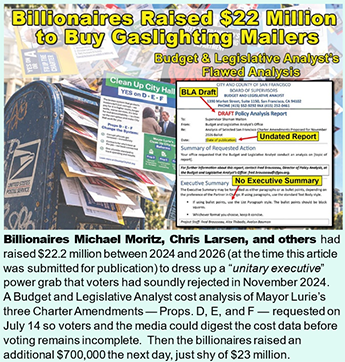
Twenty-two million dollars. That’s roughly what a small club of billionaires has now raised across two election cycles trying to buy City Hall “reform”: $9.9 million in 2024 for a “Prop D” voters flatly rejected, and nearly $12.3 million more this year (as of October 3) to resurrect it as “Props A, D, E, and F.” This year’s haul has already blown past the entire 2024 campaign, and the checks keep clearing.
So what exactly are they buying? Thanks to a belated analysis by the Board of Supervisors’ own Budget and Legislative Analyst (BLA) that surfaced barely a week before ballots hit mailboxes, we finally know. A Mayor able to fire 27 department heads at will, including the Police, Fire, and Public Health chiefs, instead of just five. A City Administrator on a ten-year term with exclusive power to write the City’s procurement laws, which the Board cannot amend. Roughly $2.5 billion in City contracts escaping Board review over three years. An unlimited number of deputy mayors at $370,470 apiece. And the initiative petition threshold quadrupled to needing 42,460 signatures, slamming the ballot box shut on everyone who can’t write seven-figure checks.
None of that is on the glossy campaign mailers.
 The Westside Observer monitored the “Commission Streamlining Task Force” created by 2024’s “Prop E” throughout 2025, and has spent much of 2026 tracking how the failed 2024 “Prop D” was systematically repackaged into four separate Charter Amendments. Combined, “Props A, D, E, and F” are a regurgitated carbon copy of the two reports the San Francisco Bay Area Planning and Urban Research organization (SPUR) issued in 2024 and 2025. Don’t be hoodwinked by the rebranding of SPUR’s same hogwash.
The 2024 “Prop D,” titled “City Commissions and Mayoral Authority Amendment,” was led by “TogetherSF Action,” heavily funded by billionaire Michael Moritz, alongside then-mayoral candidate Mark Farrell’s committee. Voters rejected it by 13.34 percentage points (56.67% “No” to 43.33% “Yes”), passing the rival “Prop E” task force measure instead.
 Splitting the package into four measures is a shell game tactic hoping voters will pass some of them, rather than reject the whole ball of wax. The goal hasn’t changed: Handing more “unitary executive” powers to San Francisco’s already “strong mayor.” Our “No Kings” concern remains.
Our main assessments of the four measures are reported in “Billionaire Boys Club Ballot Bonanza” (focusing on “Props A, E, and F”), and examined in “Voters Should Also Just Say ‘No’ on Proposition D” (focusing on “Prop D”). This final article adds late-breaking information.
Follow the Money
The Ethics Commission’s campaign finance dashboard shows Mayor Lurie’s own ballot-measure committee, ironically named “Clean Up City Hall,” had collected $8.95 million through July 15. By October 5 that had climbed to $11.86 million. Add in the $410,005 raised for “Prop A,” and the 2026 total hits $12.3 million, more than the $9.9 million a similar constellation of committees raised for 2024’s failed “Prop D.” Expect more when the second and third Pre-Election Form 460 reports land on October 22 and October 30.
Here’s a snapshot of revenue raised for “Propositions A, D, E, and F” as of October 3:
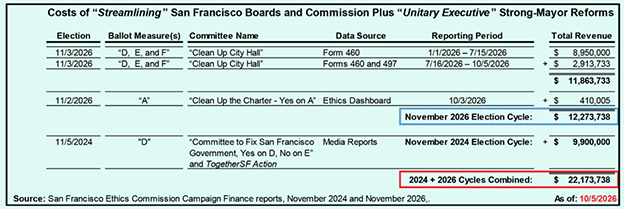
A list of the billionaires, centimillionaires, and multimillionaires bankrolling the two primary “Clean Up City Hall” committees as of October 2 can be found here. It contains the usual suspects: Michael Moritz, Chris Larsen, John Pritzker, William Oberndorf, Ron Conway, John Wolthus, Jeremy Stoppelman, John and Robert Fisher, John Doerr, III, and others. They’re so hell-bent on handing Mayor Lurie king-like “unitary executive” powers, they’re not going to stop at $22.2 million.
Voters rejected these reforms in 2024 after billionaires kicked in nearly $10 million trying to buy our votes. Now that the same special interests have thrown in another $12.3 million, the answer remains perfectly clear: Vote “Hell No” on all four. “No” on A, D, E, and F!
“Prop D” Silences Future Ballot Measures
Lurie’s “Clean Up City Hall” gaslighting arrived in mailboxes on October 3 with a Prop D-only mailer wildly claiming a “Yes on Prop D” vote will “let voters decide, not insiders.” It shrieks that “special interests game these rules to push dishonest [ballot] initiatives,” beside a PacMan-style bot claiming, “Special interests are gaming SF’s ballot system.”
 Lurie’s lack of self-awareness missed the irony that his own “special interest” billionaire pals are pushing not only Prop. D, but Props E, A, and F, too! Together, they spell D-E-A-F, because a tone deaf City Hall and its billionaire backers are less willing to hear from the voters of San Francisco Lurie serves.
As the Westside Observer reported in September, Prop D, erroneously titled “Fix Our Broken Ballot Measure Process,” doesn’t fix anything. Even Lurie’s campaign committee knows its title is a con. Prop D builds a higher wall around the ballot box, leaving the ladder only for those who can write seven-figure checks. It quadruples the signatures needed to qualify an initiative to roughly 42,000, from 2% to 8% of registered voters, silencing the handful of citizen voices who still manage to reach the ballot.
A Westside Observer analysis of the 12 most recent San Francisco primary and general elections over six calendar years found 120 ballot measures. Just 25 (20.8%) reached the ballot by petition signatures: 5 Charter Amendments, 15 Ordinances, and 5 tax measures.
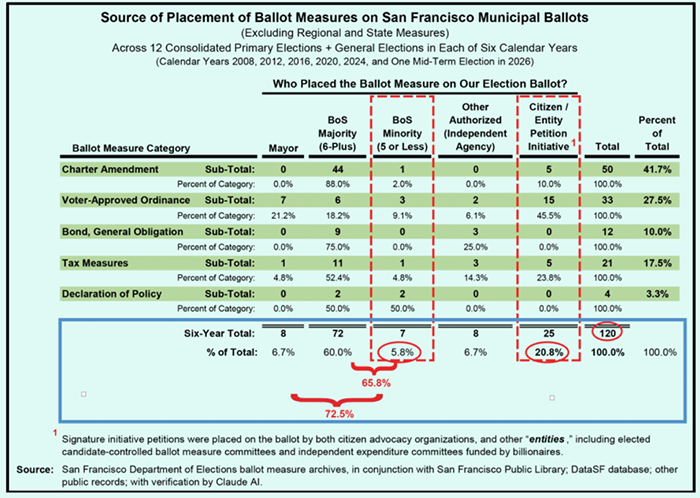
 By contrast, the Mayor placed just 8 measures (6.7%), a Board of Supervisors majority placed 72 (60%), a minority of five or fewer Supervisors placed just 7 (5.8%), and other City agencies placed 8 (6.7%).
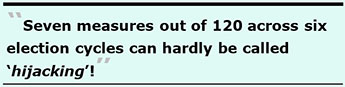
The mailer’s claim that Prop D will “stop a minority of Supervisors from hijacking the ballot” is just laughable. Seven measures out of 120 across six election cycles can hardly be called “hijacking”! Fully 90% of Charter Amendments (45 of 50) were placed by the Board; just 5 came by petition, including 2024’s failed Prop D and this year’s three “Clean Up City Hall” Charter Amendments.
Prop D also claims to strip the Mayor’s ability to place measures on the ballot. But Lurie didn’t bother using that power this year. His billionaire backers paid signature gatherers to qualify his measures through committees he created. He’s fine surrendering mayoral placement as long as billionaires bankroll petition drives on his behalf. That won’t reduce the number of measures on our ballots; it just shifts who gets to put them there.
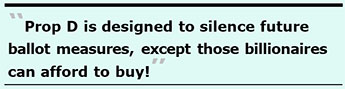
 Prop D is designed to silence future ballot measures, except those billionaires can afford to buy!
What the Billionaires Aren’t telling You
Is it significant that the Board of Supervisors failed to ask these pointed questions either before they adopted the Commission Streamlining Task Force’s final report submitted to the Board of Supervisors for consideration, or before Lurie’s posse of billionaires placed the three ballot measures on the ballot, and the Board of Supervisors separately placed Prop A on the ballot?
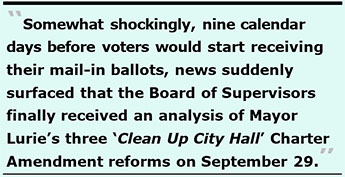
Somewhat shockingly, just nine calendar days before San Francisco voters will likely start receiving their mail-in ballots for the November 3 election, news suddenly surfaced that the Board of Supervisors had finally received an analysis of Mayor Lurie’s three “Clean Up City Hall” Charter Amendment reforms —Propositions D, E, and F — that Supervisor Shamann Walton requested on July 14. That date was notable, because it was the same date that the Board of Supervisors had voted 9 to 2 to place what became known as 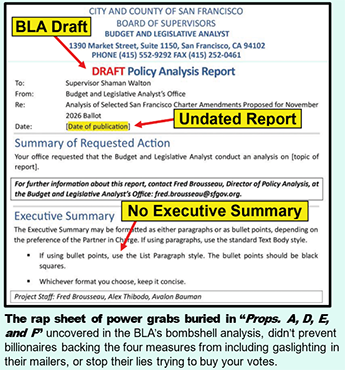 “Proposition A, Charter Changes Affecting Various Department’s [Boards and] Commissions” on the November ballot.
Supervisor Shamann Walton asked the Board’s Budget and Legislative Analyst on July 14 for an independent cost analysis of Lurie’s three Charter Amendments, Props D, E, and F, specifically requesting answers by September 8 so voters, City officials, the press, and community groups could digest them before ballots were mailed, not after.
They didn’t get them. The BLA’s overdue draft analysis surfaced only when the Board’s September 29 agenda was posted on September 25. It’s undated, still contains template placeholder text, has no executive summary, and identifies the measures by Roman numeral in reverse order rather than by ballot letter. Walton asked 14 distinct questions. The BLA boxed just eight “Requested analysis” questions, merging some, narrowing others, and dropping two entirely. As of October 5, Walton’s office hadn’t received a final version of the BLA’s analysis.
Why Walton and the Board waited until mid-July to ask the BLA for a cost analysis, after Lurie’s billionaire handlers had already banked $8.9 million in donations, is its own question. But what the draft does reveal is damning.
A six-page generative-AI critique of the BLA’s 55-page draft analysis identifies methodological lapses that would embarrass a first-year policy analyst: The BLA relied on the wrong time periods; averaged severance costs in ways that understated the price of firings; accepted the Mayor’s Office’s savings claims without verification; and built procurement-savings estimates on data it had itself discredited just two sections earlier — among other lapses. One wonders whether taxpayers would have been better served had the BLA simply used AI itself.
 “Prop D”: A Fivefold Toll on the Ballot Box
The BLA confirms required petition signatures to qualify a measure for the ballot would quadruple from 10,615 to 42,460, raising grassroots qualification costs from about $320,000 to $1.5 million. That nearly fivefold jump gets buried under a misleading cost-per-signature metric that rises only from $30.15 to $35.30. The BLA never quantified volunteer capacity despite Walton asking, never summarized turnout research, and missed the obvious irony: The Mayor’s own three Charter Amendments cleared even the 10% Charter threshold with ease. Higher signature thresholds don’t stop billionaire’s money; they stop everyone else.
“Prop E”: Prop E: A Ten-Year Procurement Czar and $2.5 Billion Escaping Review
 Prop E hands the City Administrator, a mayoral appointee, exclusive power to introduce procurement ordinances. They become law after 60 days unless the Board disapproves by motion or the Mayor objects, and the Board cannot amend them. The Mayor can kill one alone by notice; the Board needs a majority. Nothing replaces Board oversight, and the City Administrator has no plans to create any.
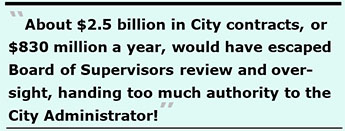
Raising contract-approval thresholds would cut Board review of expenditure contracts by 62% (from 304 to 115 over 2023–2025) and revenue contracts by 70%. About $2.5 billion, or $830 million a year, would have escaped review, with escaping amendments running as high as $15.6 million. Automatic CPI indexing shrinks review further every year. The BLA’s own examples show Board review catching real problems in exactly the mid-sized contracts that would vanish: A Mid-Market Foundation amendment cut from $7.7 million to $3.8 million after $850,000 a year in unnecessary subcontractor overhead surfaced; a Pretrial Diversion Project with no CFO and insolvency risk; and a Japanese Community Youth Council grant where a 2026 audit found $5.6 million paid without verifying eligibility. San Francisco’s $10 million threshold already dwarfs Oakland’s $50,000 and Los Angeles’ $193,000.
 Prop E also doubles the City Administrator’s term from five years to ten. Among the peer cities the BLA reviewed, only San Francisco has a fixed term at all, and a Charter Reform Working Group member warned it could let an Administrator escape the consequences of corruption or scandal.
Where the BLA fell short: It cut Walton’s five-year lookback to three years and his 20-year CPI projection to ten, excluded contracts longer than ten years, and never asked whether a contract approved below $25 million could grow past it through sub-50% amendments with no review at all. It projected procurement “savings” of $3.8 million to $23 million using a $25,000-per-procurement SPUR figure it had itself called unreliable two sections earlier. It never answered Walton’s question about institutional uncertainty. Worst, it analyzed the ten-year term in a vacuum, never connecting it to the procurement powers in the same measure: An appointee who could outlast the Mayor who appointed him by years while writing the City’s procurement law, in a City whose own recent contracting scandals the BLA never mentions.
 “Prop F”: A Mayor Who Can Fire Your Police Chief at Will
Today the Mayor fully controls removal of just 5 of 62 department heads. Under Prop F, at-will removal authority leaps to 27, including the heads of Police, Fire, Public Health, MTA, PUC, the Airport, and Rec and Park, while full appointment authority rises from 5 to 11. Commissions that must now submit at least three finalists could send the Mayor a single name.
The BLA called the turnover cost “modest,” about $225,000 a year. It got there using the wrong time span (4.25 years, not five) and by averaging $247,225 in severance across all 26 departures rather than the three that actually drew it, about $82,400 each, not $9,509. Corrected, doubled turnover adds roughly $604,000 a year, before the onboarding, acting-director pay, and lost institutional knowledge the BLA never costed. But the real cost isn’t severance: Department heads who can be fired at will have every incentive to tell the Mayor what he wants to hear.
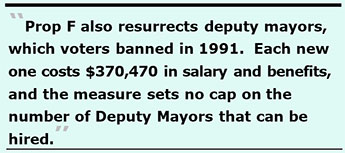 Prop F also resurrects deputy mayors, which voters banned in 1991. Each new one costs $370,470 in salary and benefits, and the measure sets no cap on the number of Deputy Mayors that can be hired. At Boston’s 14, that’s about $5.2 million a year; the BLA mentions Boston but never models it. Lurie’s four existing “Policy Chiefs” could be promoted to Deputy Mayor and then replaced, and given San Francisco’s obsession with bloated senior management, even Deputy Mayors will need, or may want, their own deputies. Those deputy mayors could supervise departments the Charter assigns to commissions, the City Administrator, or even elected officials, yet the BLA treats it as a payroll question.
The BLA also silently dropped Walton’s question about Policy Chief Alicia Jean Baptiste’s prior SPUR pay, despite pulling IRS Form 990’s from 15 other nonprofits. A five-minute Internet search by the Westside Observer found SPUR’s 2024 Form 990: Baptiste was paid $380,370 as SPUR’s President and CEO between April 1, 2024 and March 31, 2025, before decamping to Lurie’s office.
Finally, Prop F lets the Mayor move Charter-assigned functions, abolish departments, and fold them into the City Administrator’s office through ordinances “deemed approved” unless the Board disapproves within 60 days. The BLA’s case study, the DBI-Planning merger, rests entirely on the Mayor’s Office’s unverifiedclaims of “no direct cost” and “$3 million savings,” and that merger is proceeding under existing authority, so it illustrates nothing. Worse, Planning’s org chart already 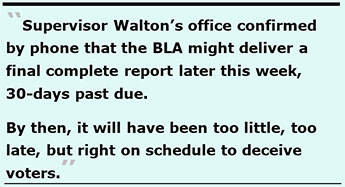 schedules a “Fully Integrated PermittingDepartment” for FY 2028, flagged “Charter Reform November 2026.” The administration is restructuring around a vote that hasn’t happened yet!
Kept in the Dark, by Design?l
Every one of these findings, from 27 department heads fireable at will, to $2.5 billion in contracts escaping Board of Supervisors oversight, to a ten-year procurement czar, to unlimited deputy mayors, to a ballot box walled off for all but the wealthy, should have been in front of voters and the Board of Supervisors months ago. Instead, the BLA’s draft limped in 17 days past Walton’s own September 8 deadline: Unfinished, undated, still dressed in template boilerplate, and days before ballots hit mailboxes.
On October 5, Supervisor Walton’s office confirmed by phone that it had received only the BLA’s undated, incomplete draft, around September 25, and still has no completed final analysis. His office indicated the BLA might deliver a final report later this week. At that point, it will hit 30-days past due. By then, of course, voters may already have their vote-by-mail ballots in hand, and many will have already cast them. Too little, too late, but right on schedule to deceive voters.
 Meanwhile, the Mayor and his billionaire backers, sitting on $12.6 million in campaign cash, have continued using their gaslighting claims, willfully ignoring every word of the buried rap sheet of power grabs uncovered in the BLA’s bombshell analysis. Those mailers rail about “insiders” and “special interests” gaming the system. Not one mention that Prop F lets the Mayor fire the Police Chief at will, or that Prop E lets his appointee write procurement law the Board can’t touch.
Was the BLA report’s late delivery deliberate? Was it purposefully delayed to keep it away from the news media? One has to wonder.
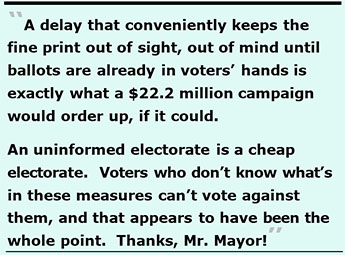
A delay that conveniently keeps the fine print out of sight, out of mind until ballots are already in voters’ hands is exactly what a $22.2 million campaign would order up, if it could. An uninformed electorate is a cheap electorate. Voters who don’t know what’s in these measures can’t vote against them, and that appears to have been the whole point. Thanks, Mr. Mayor!
Props A, D, E, and F are simply the next installment of the same con: Dress a power grab up as “reform,” let a handful of billionaires bankroll the marketing, and hope voters don’t read past the mailers. They’re Lurie’s plan to fix problems that don’t exist.
Put these billionaires on a leash: Read the fine print, and vote “No on D-E-A-F,” too.
No King-Mayors!

Monette-Shaw is a columnist for San Francisco’s Westside Observer newspaper, a member of the ACLU, and a “Democracy Watchdog” member of the California First Amendment Coalition (FAC). He operates stopLHHdownsize.com. Contact him at monette-shaw@westsideobserver.com.